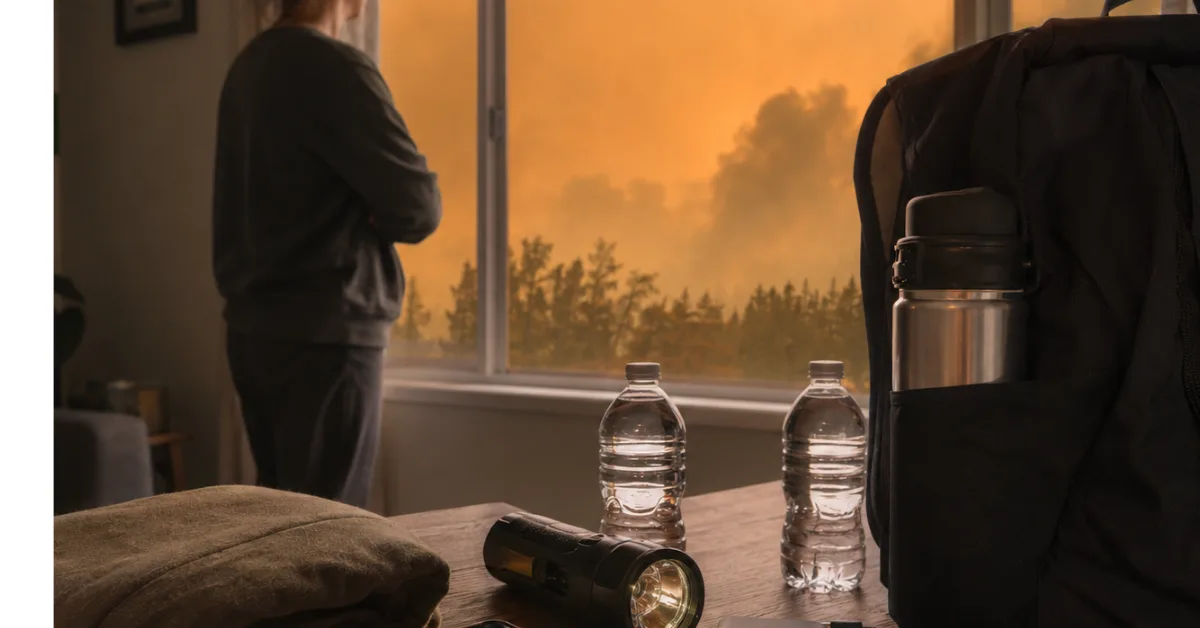
A wildfire does not have to be directly outside your home to become dangerous. Smoke can travel many miles, air quality can deteriorate quickly, and damaged power lines or precautionary shutdowns may cause a power cut at the same time. Air conditioning, ventilation, electric shutters, garage doors or warning systems may then no longer work as usual. Knowing what to do beforehand saves valuable time.
If there is clearly smoke outside and no evacuation order has been issued, keep windows and external doors closed. Do not open them out of habit to air the room. Smoke and fine particles can enter the building directly. Close any outside-air vents as well. With ventilation or air-conditioning systems, the important question is whether they draw in outdoor air. Where possible, switch to recirculation or turn the system off if it brings in unfiltered outside air. During a blackout it may stop anyway.
Choose a room that can be separated from the outside as effectively as possible. Keep drinking water, flashlights, medication, a phone, power bank and important documents ready there. People with asthma or other respiratory conditions should not have to search for essential medication once the smoke becomes thicker. Avoid adding pollution indoors: smoking, candles, open flames and unnecessary frying all worsen indoor air.
A closed house is not a reason to ignore an evacuation order. If the fire service, police or civil-protection authorities tell you to leave, do not wait to see whether the fire passes by. Prepare a bag early with documents, medicines, water, chargers, some clothing and important personal items. Anyone who begins packing only when flames are visible may lose valuable time.
Prepare the vehicle as well. Park it, if possible, so that you can drive away without manoeuvring. Keep the fuel tank or battery sufficiently charged. Have the keys, some cash and a paper map ready. During a power cut, mobile networks, navigation, traffic lights and gas stations may be affected. Plan at least one alternative route and do not rely solely on the fastest route shown by a navigation app.
Electric garage doors and gates are another often overlooked problem. Check beforehand how they can be opened manually during a power failure. An evacuation must not fail because the vehicle is trapped behind an unpowered gate. However, do not wait until smoke or fire is already directly at the property before dealing with the gate.
If you use a generator, never run it inside the house, garage, basement, carport or directly beside an open window. Exhaust can contain carbon monoxide, which is invisible and odorless. In very dry conditions, a generator can also become a fire hazard. Operate it only in a safe, suitable location and follow the manufacturer’s instructions and local safety rules.
Keep monitoring official warnings throughout the incident. Wind direction, smoke and fire behaviour can change quickly. A road that was open an hour ago may later be closed. If authorities tell you to leave the area, that instruction takes priority over your own plan.
The key rule is simple: if there is smoke but no evacuation order, keep the building as smoke-free as possible and prepare to leave. If an evacuation order is issued, do not delay. Good preparedness does not mean staying in the house for as long as possible. It means being able to switch in time from sheltering indoors to leaving safely.
Guides
General
18.08.2026
Smoke is moving in: Close the windows or evacuate during a wildfire blackout?
Wildfire smoke, an outage, and possible evacuation can happen together. Keep indoor air cleaner, prepare to leave, and know when official orders take priority.