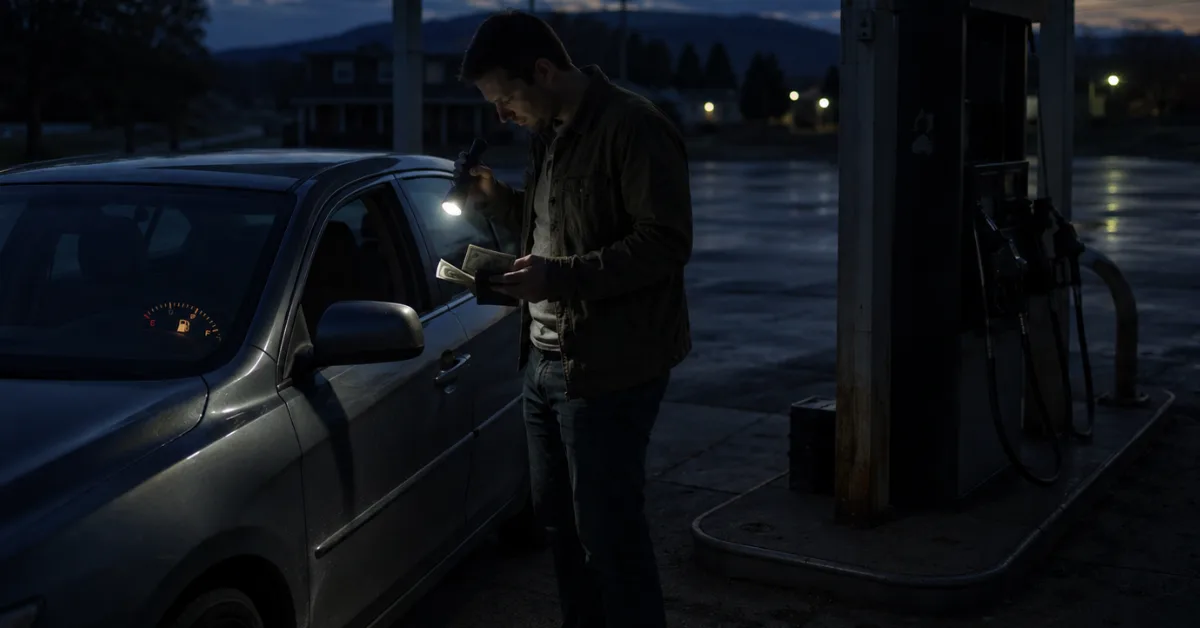
During a blackout, a car can suddenly become more important than it is in everyday life. It may take you to relatives, a doctor or an agreed meeting point. Yet that is exactly when a problem many people underestimate can appear: a gas station may still have fuel in its underground tanks, but without electricity the pumps, tills and card payments may not work. Anyone who sets off with an almost empty tank can quickly become stranded.
The simplest precaution is not to run your vehicle down to the reserve all the time. A useful rule of thumb is to avoid letting the tank remain below roughly half full for long. This does not mean constantly topping up out of fear or storing large quantities of fuel. It simply gives you a buffer if gas stations close temporarily, lose power or develop long queues.
Cash also belongs in your emergency reserve. Even if a gas station can continue operating on backup power, that does not automatically mean card terminals, internet connections or payment providers are working. Small notes can then be useful. Even so, never assume that every gas station will remain open during a widespread blackout.
Think in advance about which journeys would actually be necessary. During a large power cut, traffic lights may fail, junctions can become confusing and roads may be blocked by congestion or emergency vehicles. The car should therefore not be used for unnecessary errands. Write down important destinations such as relatives, your doctor, a pharmacy, a meeting point or a possible fallback location. A paper map, or at least maps saved offline beforehand, can help if mobile data and navigation become unreliable.
Electric-car drivers face a similar problem in another form. Public charging points also need electricity and communications. An EV should therefore not routinely be left with a very low state of charge. If you charge at home, know whether your wallbox shuts down completely when the grid fails, as it normally should for safety, and do not assume that a solar installation will automatically continue supplying electricity.
Keeping spare fuel may sound sensible, but it creates additional risks. Use only approved, tightly closing fuel containers and follow the storage and fire-safety rules that apply where you live. Gasoline or diesel must never be kept in drinks bottles, open containers or improvised cans. Do not store fuel in living areas or near flames, heaters or other ignition sources.
The vehicle itself can provide a limited source of power during an outage. USB sockets or a suitable 12-volt adapter can charge a phone or small devices, for example. Keep an eye on the vehicle battery. More importantly, never run a combustion engine inside a garage, underground parking area or other enclosed space. Carbon monoxide is invisible, odorless and can be fatal.
Also plan an alternative to the car. A bicycle, working stroller, small handcart or simply good walking shoes can be more useful for short trips than a vehicle stuck in traffic. Families should decide beforehand who would use which vehicle and make sure the relevant drivers know where the keys, cash and necessary documents are kept.
Finish with a simple mobility check: Is the fuel tank or battery sufficiently full? Is some cash available? Do you know important routes without online navigation? Is there an alternative for short distances? If you can answer these four questions before a blackout, you are not independent of gas stations and the power grid, but you are much less likely to be caught unprepared.
Guides
General
14.08.2026
Tank full, pumps dead: How to stay mobile during a blackout
Gas pumps, card payments, and EV chargers can fail during an outage. A sensible fuel or battery reserve, cash, and a mobility plan can keep you moving.