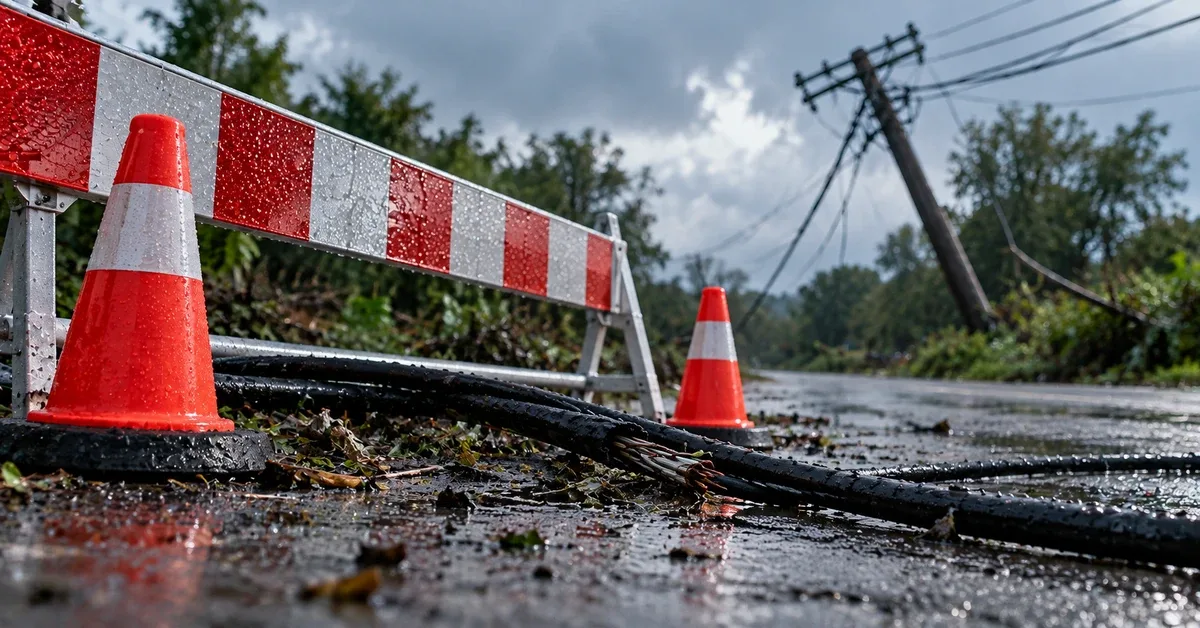
After a severe storm, the first instinct is often to start cleaning up. Branches may be lying across the road, a fence may be damaged, cables may be hanging lower than usual and the power may be out at the same time. In exactly this situation, caution is more important than speed. Damaged electrical lines can remain energized even when there is no electricity inside your own home.
The most important rule is therefore simple: keep away and do not touch anything that may be in contact with a damaged line. That includes not only the cable itself, but also branches, trees, fences, antennas, vehicles, scaffolding or wet objects. Electricity can travel through conductive materials. A line lying quietly on the ground must never be assumed to be dead.
Prepare your household before storm season. Think about the routes your family, children or pets normally use: front door, driveway, garden, garage, trash area and the route to the street. Decide in advance on an alternative path if a tree or line blocks one of those areas. At night, keep a strong flashlight within easy reach so nobody accidentally walks into a dangerous area in the dark.
After the storm, begin any inspection from a safe distance. Stay inside the building or in a protected location first and look around before going outside. If lines are hanging unusually low, cables are on the ground or branches are touching wires, do not enter the area. Keep children and animals away and warn neighbors without putting yourself closer to the hazard.
Report damaged lines to the local network operator or emergency services. Describe the location as accurately as possible. Do not try to pull away a branch, lift a cable with a broom or move a vehicle that is touching a line. Household insulating gloves, rubber boots or dry wooden poles do not make such work safe.
Take extra care around water. Puddles, flooded roads, wet ground and metal objects can make the situation difficult to assess. If a line is lying in water or electrical equipment has been flooded, keep out of the area. Do not enter a flooded basement if sockets, distribution boards or other electrical installations may be affected.
A small storm-safety kit near the exit is useful: a flashlight or headlamp, high-visibility vest, mobile phone, power bank and the telephone number of the network operator. These items are not intended for carrying out repairs yourself. They help you identify a hazard, remain visible and contact professional assistance.
Even after an official message says that power has been restored, it is worth checking your own connection. If your building remains dark while neighbouring homes have electricity again, the service line to your property or equipment inside the building may be damaged. The network operator or a qualified electrician should investigate before anyone improvises.
A storm-related outage therefore does not end when the rain stops. The most dangerous phase can begin afterwards, when people start cleaning up and overlook damaged infrastructure. Deciding beforehand which routes to avoid, who supervises children and animals, and how to contact the network operator reduces a preventable risk and may stop property damage from turning into a serious injury.
Remember: if a power line is damaged or its condition is unclear, do not approach it, do not touch anything nearby, keep the area clear and report it.
Guides
General
24.09.2026
After a storm and blackout: Stay safely away from damaged power lines
Severed or sagging power lines can remain live after severe weather. A simple safety plan helps protect your family and neighbors.