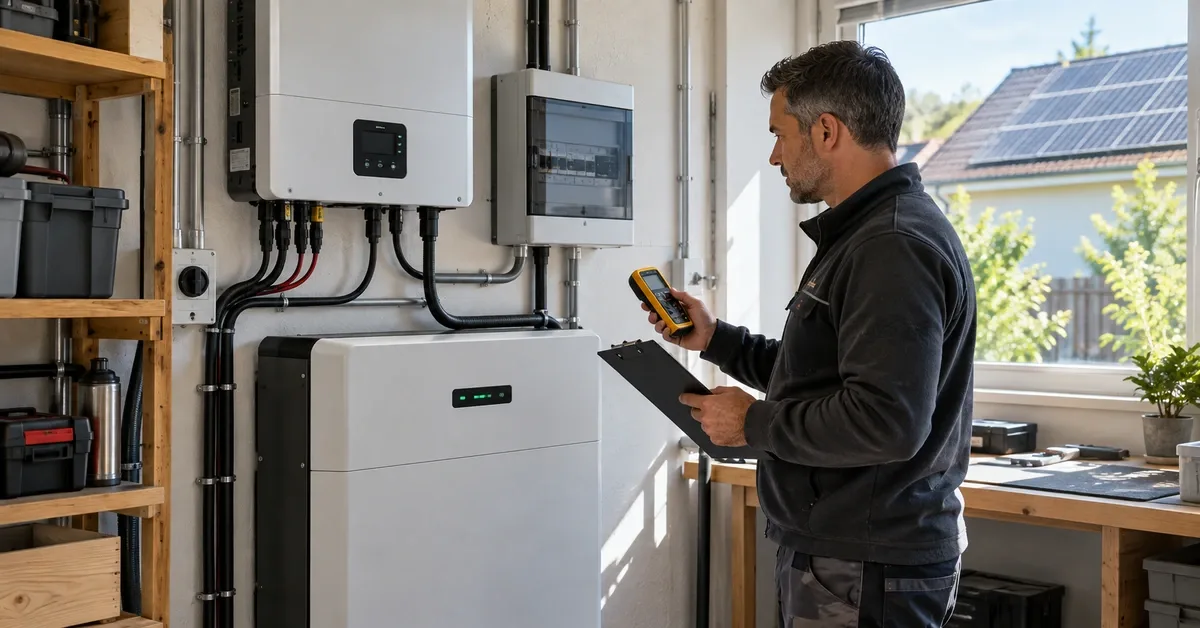
Solar panels on a roof can create a strong sense of security: if the sun is shining, surely electricity should still be available during a power outage. In many homes that assumption is wrong. Standard grid-connected photovoltaic systems automatically shut down when the public grid fails, for safety. Without a purpose-built backup-power or island-mode function, the house can remain dark even while sunlight is hitting the panels.
That is why a practical preparedness test is worthwhile before a real outage happens. Start by checking the documentation for your system to see whether the inverter and battery actually support backup power, emergency power or island operation. Manufacturers use these terms differently. Some systems supply only one emergency socket, others a dedicated circuit, and some can support several phases of a home. What matters is not the advertising claim but what your specific installation is designed to do.
Next, determine which appliances would be supplied in backup mode. Make a short list of important loads: fridge, freezer, a few LED lights, router, chargers and, where necessary, essential medical equipment. Large loads such as electric ranges, instantaneous water heaters, heat pumps or air conditioning can drain a battery quickly or exceed the available backup output. Plan priorities rather than trying to maintain normal everyday consumption.
Only perform a functional test according to the manufacturer's instructions and your electrician's guidance. Do not open distribution boards, change protective devices by guesswork or attempt to feed power into the house wiring with improvised cables. Incorrect back-feeding can energise lines and endanger people working on a network they believe to be isolated.
If your system has a designated test mode, or if an electrician can safely simulate a grid failure, have the changeover checked. Note which sockets and circuits remain live, how long the transfer takes and whether important devices restart automatically. Clearly label the outlets or circuits that receive backup power. In a dark house you should not have to discover from scratch what still works.
Then carry out a realistic runtime test. Record the battery state of charge and operate only the emergency loads you intend to use. Observe over a limited period how quickly the battery level falls. That provides a more useful estimate than the nominal storage capacity alone. Remember that solar production is zero at night and may be greatly reduced in poor weather.
Also check what happens when the public grid returns. Some systems resynchronise and switch back automatically; others may require a defined sequence or acknowledgement of a fault. Ask your electrician to explain the procedure and write it down on paper. Keep the note near your flashlight and breaker panel. Repeat the test after major software updates, inverter replacement or changes to the battery system.
Finally, set a simple operating rule: during the first hours, reserve energy for refrigeration, lighting, communication and essential equipment; leave high-consumption devices switched off. Keep flashlightes, power banks, a battery radio and other independent reserves as well. Even a good solar-and-battery system can fail or reach its limits when the battery is empty.
A short test can remove a dangerous assumption. Solar panels alone are not an automatic blackout supply. Only when backup mode, changeover behaviour, available output and realistic runtime are known does the system become a dependable part of an emergency plan.
Guides
General
19.09.2026
Solar during a power outage: Test backup power and island mode before you need them
Solar panels do not automatically power a home when the grid goes down. Safely check backup mode, supplied circuits, actual output and battery runtime before an emergency.