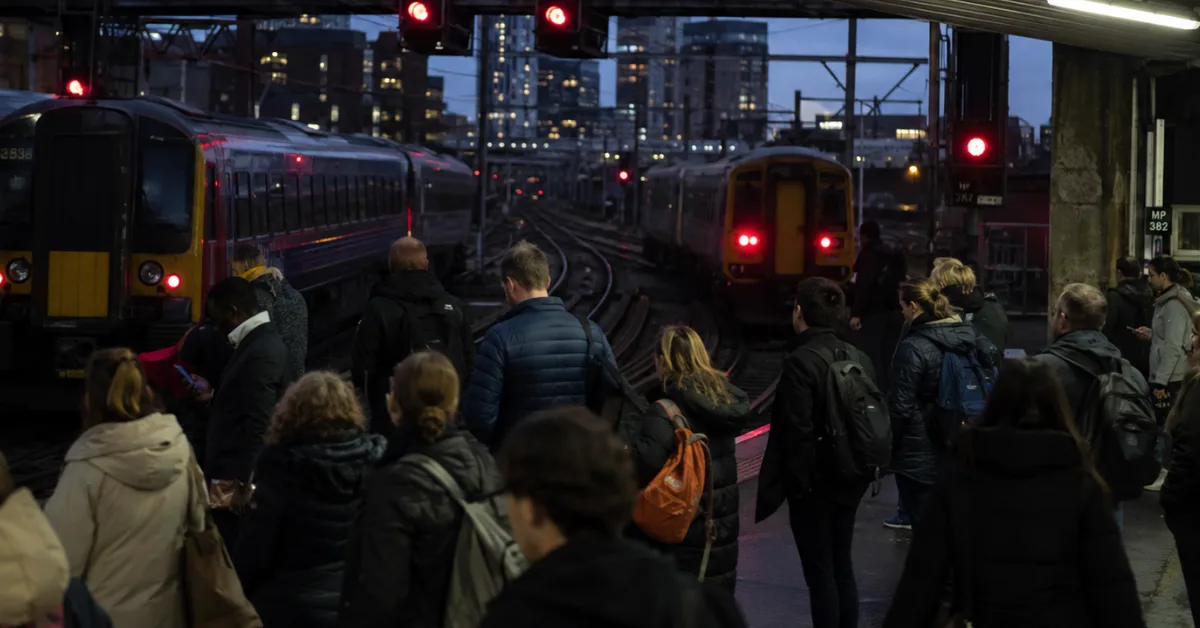
A power cut lasting only about 90 seconds was enough on Thursday, 6 August 2026, to throw rail traffic across large parts of northwest England into chaos. At about 1.40pm local time, the Manchester Rail Operating Center in Ashburys lost its normal electricity supply. What was only a very brief outage for around 5,000 electricity customers in the area became, inside a highly interconnected railway system, a disruption whose effects lasted into the following morning.
The control center is no ordinary office. Signalling and train movements on important routes around Manchester and far beyond are managed from there. When power was lost, signals automatically returned to red as a safety measure. Trains had to stop or could not be dispatched. The electricity outage itself ended quickly, but the signaling systems could not simply be returned to normal with the push of a button. Engineers had to restart systems in a controlled sequence, check them and release sections of the railway again.
The role of the emergency power supply is particularly serious. The Guardian reported that the designated generators did not start automatically. The Financial Times reported that backup systems did not react quickly enough before the signals fell back to their safe state. Those few seconds turned a very short electricity problem into hours of railway disruption. Network Rail has announced an investigation. The political reaction followed quickly as well: Greater Manchester's mayor called for answers about why such a brief outage could have such wide effects and how a repeat would be prevented. The focus is therefore not only on the original electrical fault but also on the technical redundancy of a critical control facility.
Services operated by Northern, TransPennine Express, Avanti West Coast and other companies were among those affected. Hundreds of trains were canceled or delayed. Passengers in Manchester, Liverpool and elsewhere across the northwest faced crowded platforms, changed routes and last-minute cancellations. Even on Friday morning, 7 August, trains and staff were not where the timetable expected them to be. Disruption therefore continued after the signaling technology itself had been restored.
According to SP Electricity North West, as cited by the Financial Times, around 5,000 customers were affected by the power cut. A Friday report identified an incident on a high-voltage cable in Harpurhey, north-east of Manchester city center, as the trigger. For ordinary households the outage was short. For a central infrastructure site controlling many railway routes at once, it was a direct hit.
The incident shows why the duration of a power cut alone says little about its real consequences. Ninety seconds sounds harmless. But if a central control system, operations room, data center or communications facility loses function at exactly that moment, the effects can still be visible many hours later.
For blackout preparedness, the lesson is important: emergency power must not merely exist; it must take over on time and reliably. Batteries, UPS systems and generators only help when they are maintained, tested and designed to bridge the critical seconds between grid failure and replacement supply. Manchester is a reminder that modern daily life can depend on a small number of central technical nodes – and that sometimes less than two minutes is enough to knock an entire system out of rhythm.
Source: Financial Times, 6 August 2026; The Guardian, 6 and 7 August 2026; TransPennine Express, 6 August 2026; SP Electricity North West, cited by the Financial Times.
Latest updates
General
07.08.2026
Just 90 seconds without power – and northern England’s rail network descends into chaos
A brief outage at the Manchester Rail Operating Center stopped trains across northwest England. The worrying part: backup power did not respond fast enough.