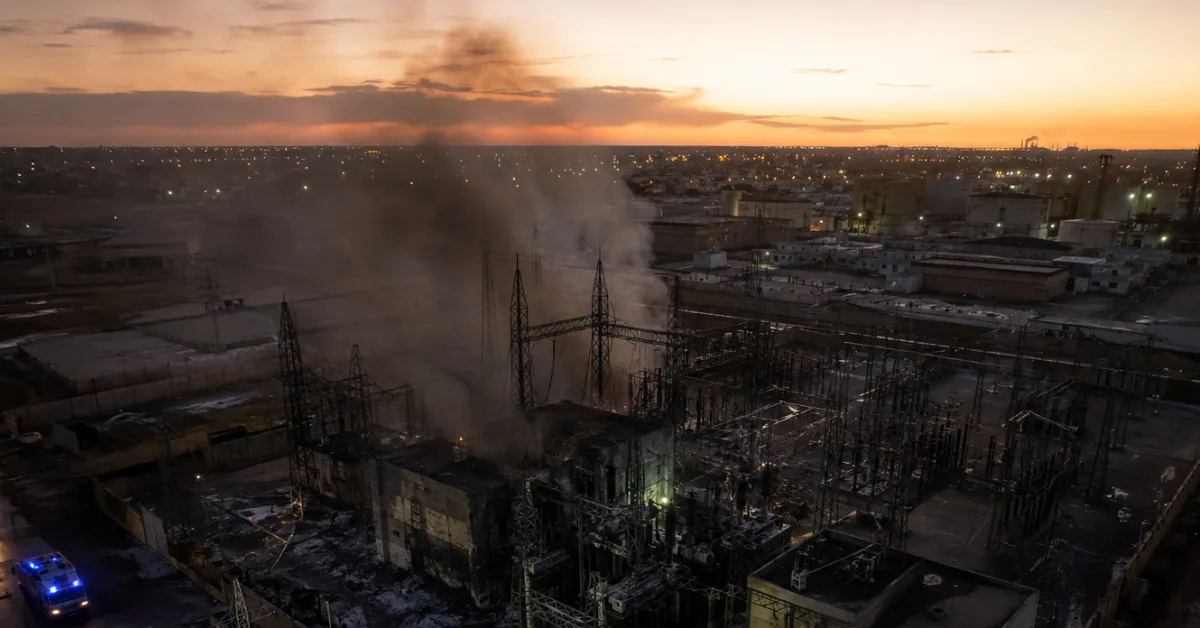
A drone strike on a major electricity substation in the western Libyan city of Zawiya triggered a widespread power outage early on Wednesday. According to the state-run General Electricity Company of Libya, the facility in the southern part of the city was completely burned down. Large areas south of Zawiya subsequently lost their electricity supply.
The attack has hit a city of enormous importance to Libya's energy system. Zawiya lies about 47 kilometers west of the capital, Tripoli, and has around 250,000 residents. Libya's largest oil refinery, an export terminal, power facilities and important grid infrastructure are located in and around the city. In recent days, precisely this infrastructure has repeatedly been targeted by drone attacks.
Particularly alarming is that the latest strike did not merely damage a single power line. The state electricity company said the substation was completely destroyed. Such facilities are crucial nodes in an electricity system: they connect generation and the transmission grid with regional distribution networks. If such a node fails, even available generating capacity cannot easily reach the affected consumers.
The consequences apparently extend beyond the destroyed substation. Reuters reported that U.S. company GE suspended all work at the Zawiya power station and withdrew staff because of security concerns. As a result, more than 700 megawatts of the plant's roughly 1,300 MW capacity remain offline. For an electricity system already struggling with technical problems, political tensions and recurring supply difficulties, that is a significant loss.
The strike is part of a series of attacks. Fuel tanks and other energy facilities in Zawiya's industrial complex had already been targeted by drones. One tank containing about 4.5 million liters of gasoline collapsed after a fire. Libya's National Oil Corporation later said the fires had been brought under control. Engineers said the refinery itself had not been damaged in those attacks.
Who is behind the drone attacks has not been confirmed. According to the Associated Press and Reuters, no group has claimed responsibility. Libya's government condemned the attacks on oil and energy facilities as a dangerous escalation. The National Oil Corporation had already warned that it might have to declare force majeure if attacks on energy facilities in Zawiya continued.
For residents, the situation means more than dark homes. A prolonged power outage can affect pumps, mobile communications, refrigeration, shops, fuel stations and water supplies. Damage to energy facilities also complicates restoration because crews may need to do much more than reset protection equipment or repair a line: destroyed high-voltage infrastructure may have to be replaced. For many residents, a local strike can therefore quickly become a problem affecting everyday life as a whole.
The incident clearly demonstrates how vulnerable centralized energy infrastructure can be in a crisis region. A single targeted attack on an important grid node can affect large areas, while additional strikes can simultaneously weaken generating and fuel capacity. Grid operators then face both technical damage and serious security risks for repair crews.
It was not immediately clear how long the affected areas would remain without reliable electricity. What is clear, however, is that Zawiya is not dealing with an ordinary technical outage, but with a direct attack on critical energy infrastructure whose consequences could extend far beyond a single substation.
Sources: Reuters, 12 August 2026; Associated Press, 12 August 2026; General Electricity Company of Libya; National Oil Corporation Libya.
Latest updates
General
12.08.2026
Drone strike destroys substation: Widespread power outage hits Libya
A drone strike has completely destroyed a key substation in Zawiya. Large areas south of the city lost power while more generating capacity remains offline.