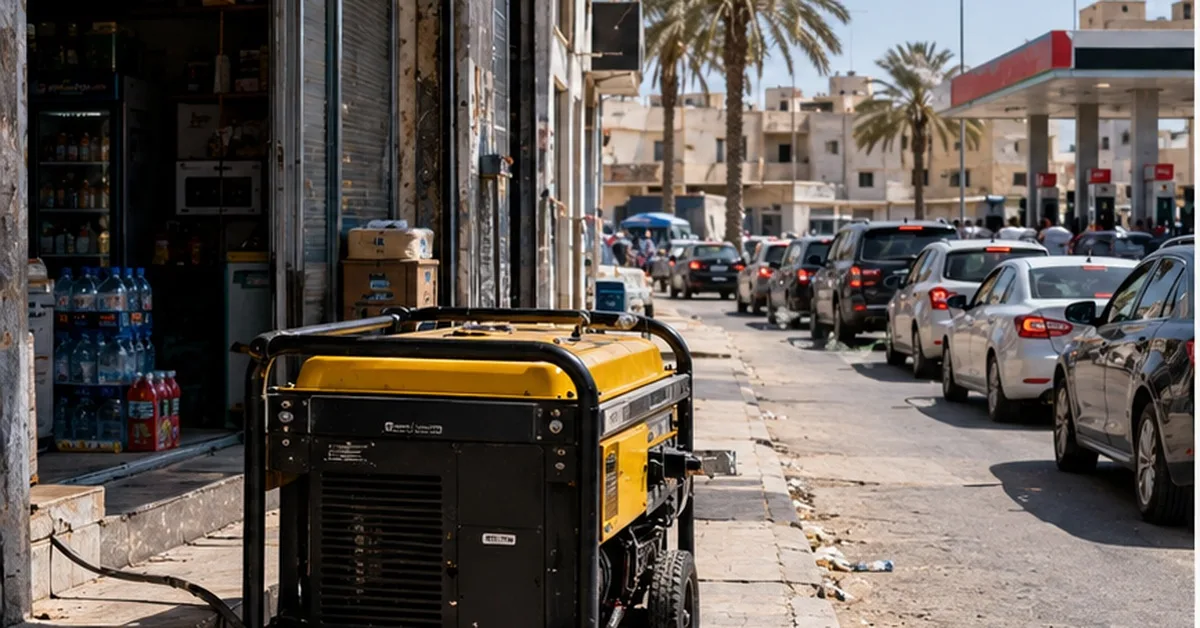
Libya is in the middle of an electricity and fuel crisis that demonstrates how closely an unstable power grid and fuel availability can become linked. Reuters reported from Tripoli and Benghazi on September 17, 2026, describing frequent power cuts, long queues at filling stations and sharply rising costs for private backup generation. Small businesses are under particular pressure because they lose revenue while spending increasing amounts on diesel generators.
One restaurant owner in Tripoli told Reuters that the electricity failed more than ten times during an interview. To keep refrigeration and his restaurants operating, he has to use generators and buy diesel on the black market. He estimated losses caused by the electricity crisis at about 40,000 US dollars over recent months. That figure represents one business, but it illustrates very clearly how expensive repeated outages can become.
The problem did not begin yesterday. Libya has struggled for years with an electricity system affected by ageing infrastructure, inadequate maintenance and political conflict. Severe heat and high demand made conditions worse this summer. As early as June, the state-owned General Electricity Company of Libya warned of a generation deficit exceeding 1,000 megawatts after power stations lacked sufficient gas and other fuels.
At the end of August, western Libya experienced a major partial blackout. According to GECOL, two important 400-kilovolt transmission circuits went out of service. Grid frequency fell rapidly from 50 hertz to around 47.5 hertz. The balance between generation and demand was lost, leaving large areas of Tripoli and other western regions without electricity. The precise cause was to be determined through a technical investigation.
The current crisis has a second layer: fuel for backup power is itself becoming scarce or expensive. Reuters reports that filling-station queues can extend for as much as two kilometres in parts of the country. Diesel that is heavily subsidised at the official price is sold on the black market for many times that amount. At the same time, Libya loses substantial volumes of fuel through smuggling and, despite its large oil reserves, imports much of its refined fuel.
This creates a dangerous dependency. When the public grid fails, generators take over. The longer and more frequently outages occur, the more diesel is required. If fuel becomes scarce at the same time, private backup power also loses reliability. Shops, cold chains, medical facilities and households can no longer assume that owning a generator solves the problem.
That point matters far beyond Libya. A generator or portable power station can be an excellent reserve, but it does not replace a complete preparedness plan. Fuel is finite, batteries eventually empty and every backup system has a maximum output.
Libya is not facing a newly announced nationwide blackout. Instead, it is experiencing a prolonged supply crisis in which power cuts, heat, weak infrastructure and fuel problems reinforce one another. That makes the situation particularly relevant for blackout preparedness: the first hour without electricity is not the only challenge. What matters is how long your own reserves can genuinely keep essential functions running.
For personal preparedness, the main lesson is to consider several supply failures together. Planning only for the loss of grid electricity can overlook the second bottleneck: resupply. A resilient plan therefore treats energy, fuel, refrigeration, water and communications as one connected system and sets clear priorities for an outage that lasts longer than expected.
Latest updates
General
18.09.2026
Libya: power cuts and fuel shortages reinforce each other
Libya is in the middle of an electricity and fuel crisis that demonstrates how closely an unstable power grid and fuel availability can become linked. Reuters reported from Tripoli and Benghazi on September 17, 2026, describing frequent power cuts, long queues at filling stations and sharply rising costs for private backup generation. Small businesses are under particular pressure because they lose revenue while spending increasing amounts on diesel generators.