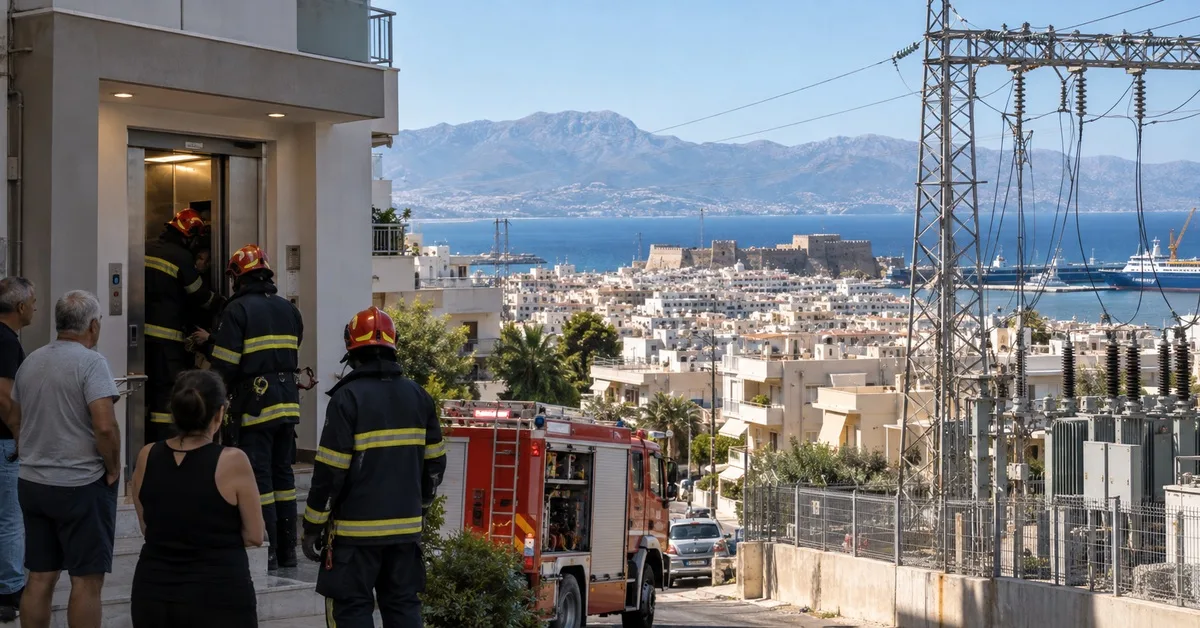
Crete experienced a widespread power outage on Monday, 7 September 2026, affecting areas across all four regional units of the island. Greek media reports consistently linked the incident to a fault in the major electricity connection between Crete and mainland Greece. Heraklion and other parts of the island were among the affected areas. The disruption occurred during the morning and temporarily cut electricity to homes, businesses, public facilities and parts of urban infrastructure.
The consequences were especially visible in elevators. The fire service received more than 30 calls involving people trapped in lifts, including more than ten cases in Heraklion alone. Firefighters opened the affected elevators and freed the occupants. No injuries were reported in the available accounts. The number of rescue calls shows how quickly a technical grid problem can become an immediate public-safety issue.
Greek reports said the fault was associated with the large Athens–Damasta electrical interconnection and was located on the mainland side of the system. Crete is now much more strongly connected to Greece’s national electricity network than in the past. Under normal conditions, the interconnection reduces dependence on local power stations and improves security of supply. When a key element of that connection fails, however, the island system must react rapidly.
That is what happened this time. Local generating units and reserve capacity on Crete were brought online to support restoration. Reports referred to plants at Atherinolakkos, Linoperamata and Chania. Using those local units, operators gradually rebuilt electricity supply while technicians dealt with the interconnection problem. By the afternoon, Greek media reported that power had returned to the affected areas.
The event is a useful example of why redundancy matters in electricity systems. Connection to the mainland increases stability during normal operation, but local generation or other reserves still need to remain available in case the interconnector itself fails. A reserve is valuable only if it is operational and can be activated quickly.
For households, the story also carries a practical lesson. A power outage does not have to last for days to create real danger. People can become trapped in lifts, payment terminals and traffic signals can fail, mobile or internet services may be interrupted and powered doors or pumps can stop unexpectedly. In hotels, apartment blocks and offices with many elevators, the first moments of an outage can be particularly difficult.
Preparedness should therefore go beyond food, water and lighting. Location matters too. When power appears unstable, avoiding elevators is sensible, especially if stairs are available. Families should know how to move through their building without a lift and should discuss this in advance with children, older relatives or anyone with limited mobility. Official information should be followed, and damaged electrical equipment should never be investigated by unqualified people.
The Crete outage did not last equally long everywhere and did not develop into a days-long island blackout. That is precisely why it is relevant. A single failure on a central connection was enough to disrupt large parts of a modern tourism region within a short time. The fact that local generating units could support restoration shows the value of keeping genuine backup capacity ready.
Sources: To Vima, 7 September 2026; News247, Eleftheria and additional Greek media reports dated 7 September 2026.
Latest updates
General
08.09.2026
Crete: mainland interconnector fault triggers widespread outage and more than 30 elevator rescues
On 7 September, power failed across parts of all four regional units of Crete. A fault in the island’s link to mainland Greece was blamed, while local generation helped restore supply.