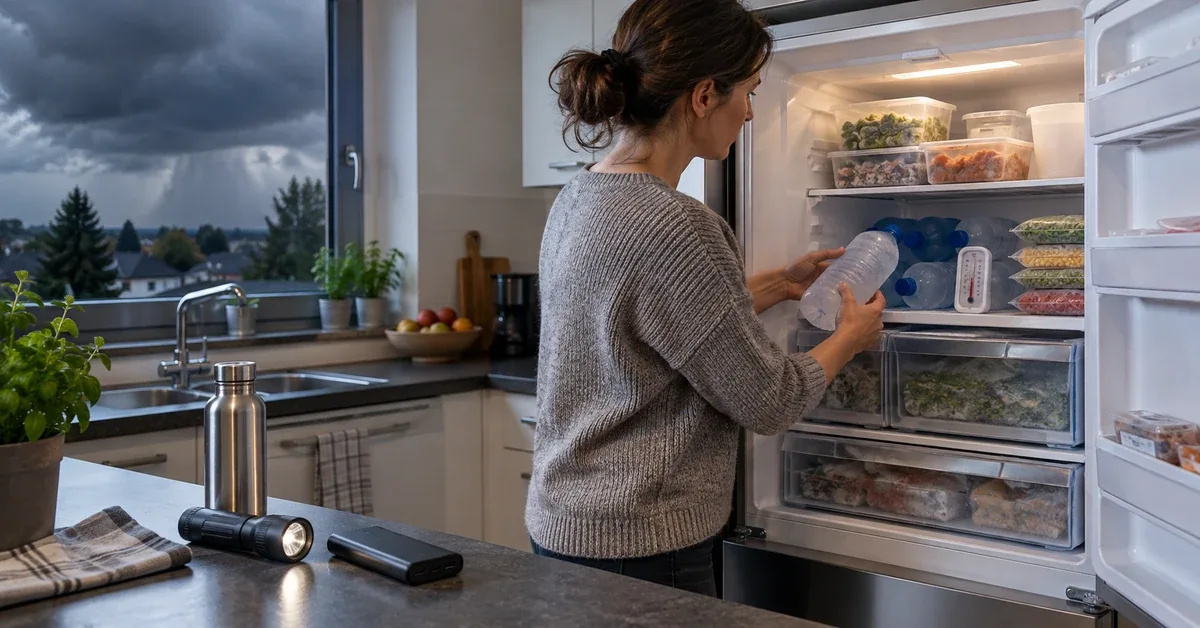
When severe weather is forecast, many people first think about flashlights, power banks and closing windows. Yet an often overlooked part of blackout preparation is already in the kitchen: the refrigerator and freezer can become passive cold-storage systems for several hours. Preparing them before a possible outage buys time and reduces the risk of having to throw food away.
The first step is a simple thermometer. A small refrigerator and freezer thermometer shows how much the temperature has actually changed after the power fails. The appliance control setting does not provide that information. Official food-safety agencies generally recommend keeping a refrigerator at about 40°F, or roughly 4 to 5°C, or below during normal operation and a freezer at 0°F, or about -18°C. Starting from a safe temperature gives the household a stronger cold reserve.
If a storm, typhoon or other severe-weather event with a risk of power outages is forecast, the freezer should be reasonably full. Empty spaces can be filled with freezer packs or suitable plastic containers of frozen water. Do not fill containers completely because water expands as it freezes. A larger continuous mass of cold material warms more slowly than many small items separated by open air.
Food itself can also be prepared. Items that will be needed over the next few days and can safely be frozen may be moved into the freezer ahead of time. At the same time, decide before the storm which refrigerated foods should be used first if the outage lasts. That prevents repeated door opening just to inspect what is inside after the electricity has already failed.
Once the power goes out, one rule matters above all: keep the refrigerator and freezer doors closed as much as possible. The UK Food Standards Agency and the US Department of Agriculture use about four hours as a guideline for an unopened refrigerator. A full freezer may stay cold enough for about 48 hours, while a half-full freezer may last about 24 hours. These are estimates, not guarantees. Room temperature, appliance design, loading and the starting temperature all affect the real time available.
For a longer outage, keep a clean insulated cooler available. Frozen gel packs or ice can protect sensitive food when the refrigerator can no longer maintain a safe temperature. People living in storm-prone areas may also want to know ahead of time where block ice can be purchased. Dry ice can extend cooling as well, but it requires special handling, must not be touched with bare hands and should never be used carelessly in poorly ventilated spaces.
When electricity returns, smell and taste are not reliable tests of food safety. Perishable products should be evaluated using temperature, outage duration and official recommendations. If there is real doubt, throwing the food away is safer than tasting it. Food that has contacted floodwater or contaminated water creates a separate sanitation risk and needs additional caution.
A practical option is a small storm cooling kit: two to four frozen packs, a thermometer, an insulated bag or cooler, watertight containers and a short list of the foods that spoil most easily. Keep everything in one known location so nobody has to search for it during an outage.
The principle is simple: cold can be stored. Building that reserve before a weather warning turns a refrigerator and freezer into a temporary buffer for several hours. It does not replace backup power, but it can protect food, reduce unnecessary door opening and make a household much calmer during an outage.
Sources: Food Standards Agency, “Food safety in a power cut”; USDA Food Safety and Inspection Service, “Keeping Food Safe During an Emergency”. Updated: September 2026.
Guides
General
21.09.2026
Build a cold reserve before an outage: prepare your refrigerator and freezer
When severe weather is forecast, cold can be stored deliberately. With thermometers, frozen water containers and a clear cooling plan, food can stay protected longer during a power outage.