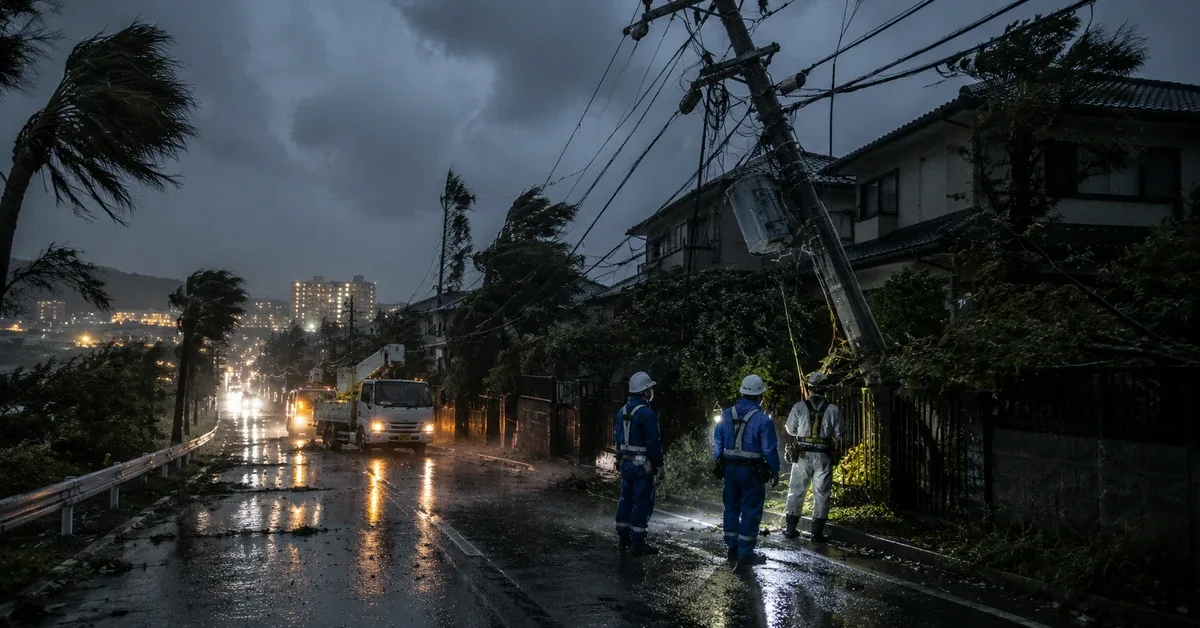
On Monday, September 21, 2026, Typhoon Dujuan struck or threatened eastern Japan with powerful winds and exceptionally heavy rainfall. Conditions worsened throughout the day around Greater Tokyo and neighboring Chiba Prefecture. The Japan Meteorological Agency warned about flooding, landslides and dangerous wind gusts. Power outages were already being reported, with media reports saying that more than 4,000 households in Chiba were without electricity at one point.
Live outage information from Tokyo Electric Power Company Power Grid also showed interruptions in Chiba and Shizuoka on Monday. The numbers changed as crews restored some customers while new faults appeared. That is typical of weather-related grid damage: one section can be re-energized while branches, falling trees, damaged utility poles or flooded equipment create a new fault somewhere else. A reliable final count of affected customers is therefore often impossible to determine until the storm has moved away.
Dujuan was far more than an electricity problem. At least 275 flights were canceled, some rail services were suspended and major events were ended early. The weather agency warned that rainfall through Tuesday could, in some locations, exceed the average amount normally received during the entire month of September. Particularly serious warnings applied to the Izu Islands and parts of the Kanto region. These conditions can also slow power restoration because crews cannot safely reach every damaged location during violent winds, flooding or landslide danger.
For households, the most important lesson is simple: a weather-related outage may be forecast as a possibility, but its exact start and duration remain unpredictable. When a typhoon, storm or extreme-rain warning is issued, there are often still several hours to charge power banks, place flashlights where they are easy to reach, avoid unnecessary opening of refrigerators and freezers, and save important information for offline access. Drinking water, essential medicines and some cash should also be ready.
Food refrigeration deserves special attention. Official food-safety agencies warn that an unopened refrigerator stays adequately cold for only a limited period during an outage, while a well-filled freezer can maintain a safe temperature considerably longer. Before severe weather arrives, unused freezer space can therefore be filled with frozen water containers or freezer packs. They create additional cold storage without forcing the household to improvise after the power is already gone.
There is another practical issue that is easy to underestimate during a severe storm: warnings and outage reports can change quickly. Anyone relying on a single app or website may miss important updates if cellular data becomes weak or overloaded. It is better to have several ways to receive information, such as local emergency alerts, a battery-powered radio and phone numbers for the utility or local authority written down in advance. Families should also agree on what to do if calls and mobile data stop working temporarily.
Japan's experience also shows why power-outage preparation and severe-weather preparation belong together. Thinking only about lights overlooks other effects: cellular networks can become congested, elevators stop, pumps fail and roads may become impassable at the same time. The problem is then not only a lack of electricity but also a reduced ability to obtain supplies or assistance quickly.
Typhoon Dujuan is not an example of a nationwide blackout. It illustrates a more common reality: extreme weather can create thousands of individual grid faults and disconnect communities for hours at a time. Precisely because these outages are local and constantly changing, useful preparation begins before the first power line fails.
Sources: Japan Meteorological Agency; Tokyo Electric Power Company Power Grid; Reuters; AFP. Updated: September 21, 2026.
Latest updates
General
21.09.2026
Typhoon Dujuan leaves thousands of households in Japan without power
Typhoon Dujuan is bringing torrential rain and damaging winds to eastern Japan. More than 4,000 households in Chiba were reported without electricity at one point as transportation and daily life were disrupted.