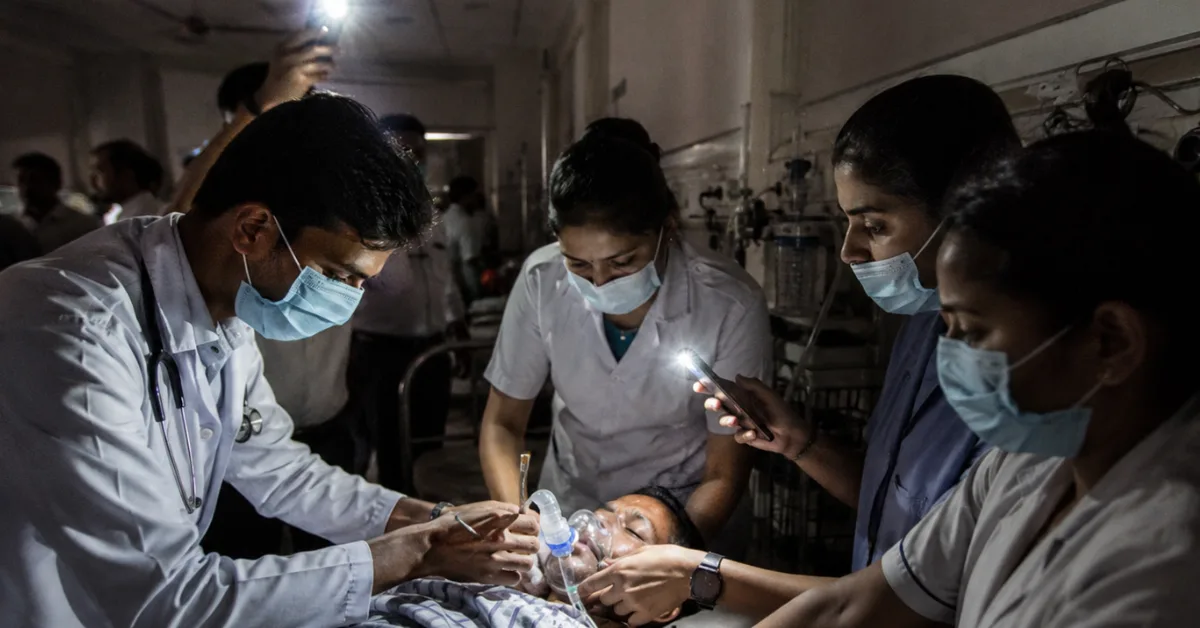
Two minutes of darkness can be enough to turn routine hospital operations into a disturbing emergency. A recent power failure at Sadar Hospital in Sasaram, in the Indian state of Bihar, became public on 8 August 2026. Doctors and nursing staff were in the middle of treating patients when the emergency ward suddenly went dark. Instead of being able to rely on normal lighting or an emergency power supply taking over immediately, they temporarily had to use the flashlights on their mobile phones.
Videos from the hospital spread quickly on social media. They show medical staff examining and caring for patients in dimly lit rooms. The images triggered criticism because an emergency department is exactly the kind of place where the electricity simply cannot be allowed to fail. Lighting, monitoring equipment, oxygen systems, communications and other medical technology can all depend on a stable power supply.
What makes the incident particularly alarming is that, according to India Today, the hospital has its own transformer as well as generators and other emergency power systems. That infrastructure is specifically intended to stop an ordinary electrical fault from reaching critical hospital operations. Yet the emergency ward still ended up in darkness.
Rohtas District Magistrate Deepak Kumar Mishra said that a preliminary inquiry indicated that a miniature circuit breaker, or MCB, had apparently tripped. This reportedly interrupted the power supply for about two minutes. Officials therefore stress that this was not a long blackout. But that short duration is precisely what makes the incident significant: in critical infrastructure, a few minutes or even a few seconds can be enough to interrupt procedures and force staff to improvise.
An investigation is now expected to determine why the existing backup systems did not absorb the outage in a way that allowed the emergency department to continue operating normally. Authorities want to establish whether technical defects, maintenance issues or organisational failures played a role. Any further action is expected to depend on the findings. Until then, an uncomfortable question remains: why did several layers of planned protection apparently fail to prevent medical staff in such a sensitive area from having to rely on private mobile phones as a source of light?
The Sasaram incident was not a huge nationwide blackout and it did not affect millions of homes. Even so, it illustrates particularly clearly what really matters during a power failure. The key issue is not only how many people lose electricity or how long the lights stay off. It also matters exactly what is left without power at that moment.
In a living room, two minutes without electricity are usually just annoying. In an emergency ward, the same two minutes can suddenly feel very long. If doctors have to pull out their phones simply to see their patients, a small technical fault immediately becomes a safety issue.
There is a clear lesson here for blackout preparedness: emergency power systems must not merely exist. They have to be tested regularly, take over automatically and work under realistic conditions. A battery in a cupboard, a generator in a basement or a UPS beside critical equipment provides real protection only when the entire chain works at the decisive moment.
Sasaram therefore shows on a small scale what can happen anywhere during larger blackouts: the technology may be installed and plans may exist, but in the end everything depends on whether the final safety layer is truly reliable.
Source: India Today, 8 August 2026; District Rohtas, Government of Bihar.
Incidents & analysis
General
08.08.2026
Two minutes in the dark: Doctors treat patients by mobile phone light
Power failure in a Bihar emergency ward: despite a dedicated transformer and backup systems, doctors briefly had to continue treatment by phone light.