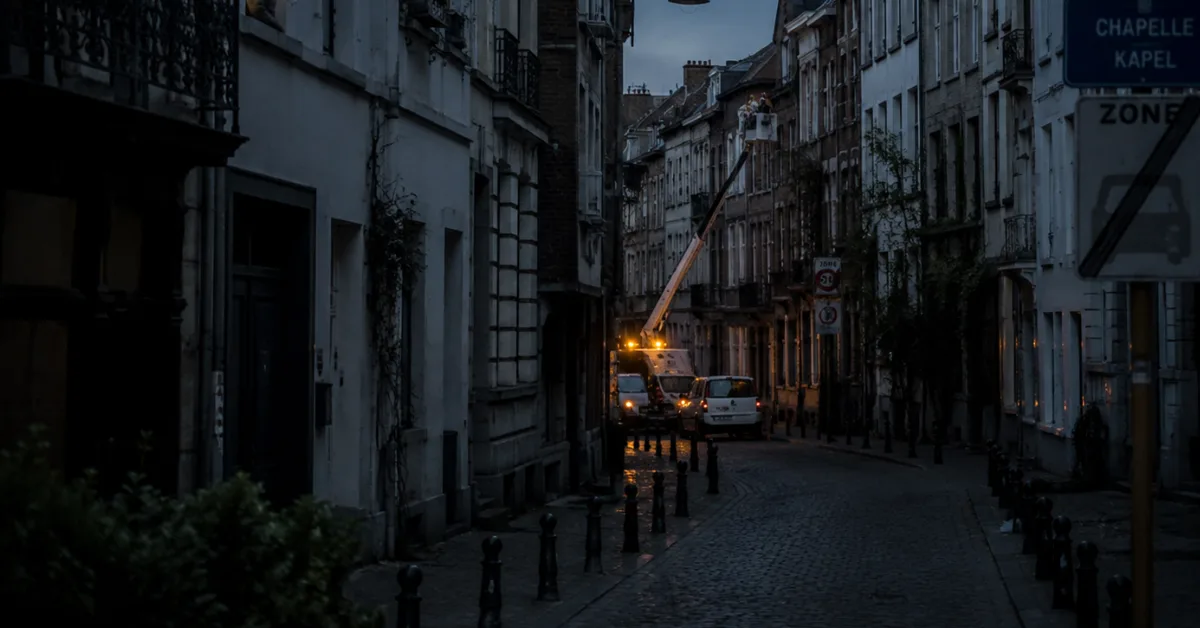
Brussels is experiencing a noticeable series of local power outages this weekend. Regional grid operator Sibelga listed several incidents in different municipalities of the Belgian capital region on Saturday, August 15, and Sunday morning, August 16, 2026. Areas affected included Ganshoren, Watermael-Boitsfort, Ixelles and Schaerbeek. Based on the information published so far, this was not one single large-scale blackout but several separately reported low-voltage outages within less than 24 hours.
The most recent entry concerned Schaerbeek. Sibelga recorded a power outage on Avenue des Glycines at 07:59 on Sunday. The initial estimated end time was 09:29. At the time shown on the public outage page, no proportion of affected customers had yet been listed as reconnected.
Ixelles had already been affected on Saturday evening. Sibelga reported a low-voltage outage on Avenue Louise, one of Brussels’ best-known streets, at 18:17, with an estimated restoration time of 19:47. Almost simultaneously, another outage was recorded in Watermael-Boitsfort on Avenue Louis Vander Swaelmen at 18:05. The expected repair time for that incident was later extended, most recently to 22:33.
According to the grid operator, an outage in Ganshoren lasted even longer. A power cut on Rue de Termonde was registered at 11:50 on Saturday. Here too, the expected repair time was extended, to 19:00. Sibelga also marked the incident with a notice that compensation might be possible under certain conditions.
The publicly available overview does not state how many households or businesses were affected in total. Sibelga also does not identify a common technical cause for the separate incidents on the overview page. It would therefore be wrong to assume automatically that the outages were part of one connected network failure merely because they occurred close together in time. Even so, it is striking that several municipalities in the capital region reported electricity problems within a short period.
Sibelga explains generally that low-voltage faults can affect individual streets or small areas. If a high-voltage cabin is affected, several streets or even an entire neighbourhood can be impacted. The current entries, however, were explicitly classified as low-voltage outages.
For context, it is also important to distinguish between a local distribution-network fault and a wider supply crisis. The cases published by Sibelga currently provide no indication of a shortage of available electricity in Belgium or a failure of the higher-level transmission grid. According to the published classification, the problems were local low-voltage incidents. For people in the affected streets, however, that technical distinction makes little difference at first: lights, sockets and connected systems still stop working.
For residents, the series shows how quickly even local outages can affect everyday life. A power cut confined to a single street can disable lifts, door systems, refrigeration, internet routers, card payments or lighting. In densely built urban areas, such an outage becomes immediately noticeable even when the wider electricity system remains stable.
The Brussels case is therefore less a dramatic citywide blackout than a current example of how security of supply also depends on local distribution infrastructure. Several smaller outages in different places can be just as unexpected for those directly affected as one major failure, while remaining almost invisible outside the streets concerned.
Source: Sibelga, public overview of current power outages in the Brussels-Capital Region, accessed August 16, 2026.
Latest updates
General
16.08.2026
Brussels hit by several local power outages within hours
Sibelga listed low-voltage outages in Schaerbeek, Ixelles, Watermael-Boitsfort and Ganshoren within less than 24 hours. There is no evidence of a citywide blackout.