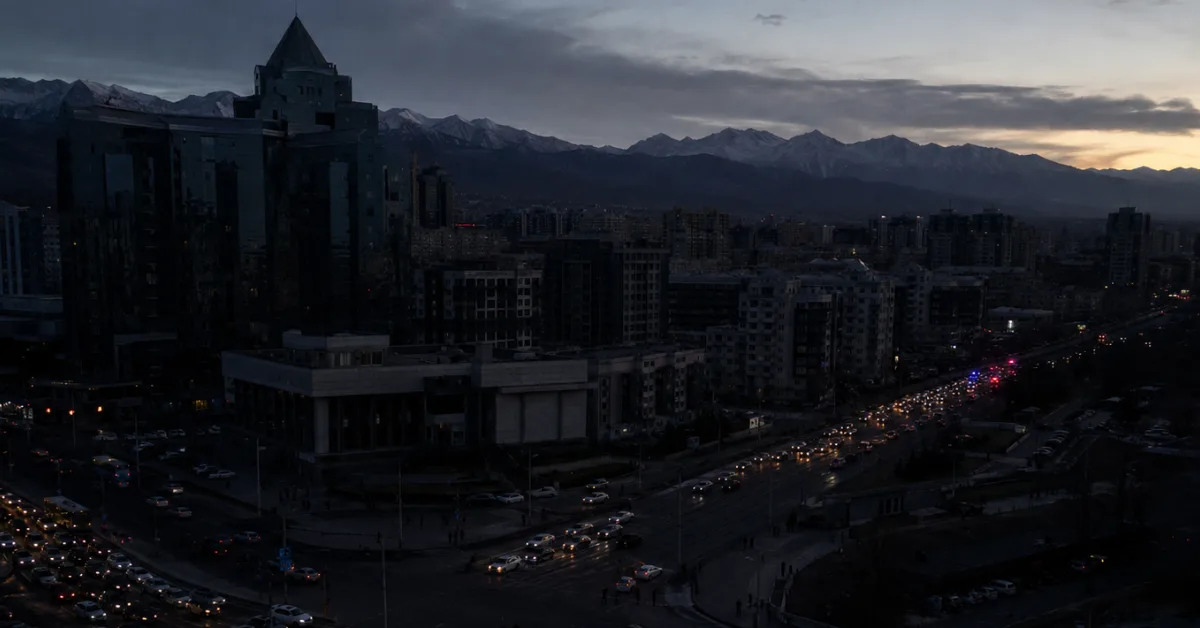
Four countries, one power problem: On Friday afternoon, August 14, 2026, parts of Kazakhstan, Kyrgyzstan, Tajikistan and Uzbekistan were hit by power outages almost simultaneously. What first looked like a local disruption quickly developed into a cross-border incident in Central Asia’s tightly interconnected electricity grid.
The effects were especially visible in Almaty, Kazakhstan’s largest city. Power failed in several districts. The metro temporarily stopped operating, traffic lights went dark and congestion formed on the streets. Reports from the city also mentioned disruptions to mobile phone service and water supplies because electrically powered pumping stations were affected. Several areas around Almaty and other parts of Kazakhstan also experienced temporary outages.
At almost the same time, residents of Bishkek in Kyrgyzstan reported losing electricity. Outages were also reported from Dushanbe and other locations in Tajikistan. In Uzbekistan, affected areas included parts of the southeastern Surxondaryo region. Within minutes, the incident demonstrated how closely the region’s electricity systems are linked: a technical problem in one place can spread through transmission lines and automatic protection mechanisms far beyond a national border.
According to Kazakhstan’s grid operator KEGOC, two generators with a combined capacity of around 600 megawatts were shut down at Kyrgyzstan’s Toktogul hydropower plant. This led to an overload on an important North-East-South transmission corridor. Protection systems reacted automatically and disconnected sections of the grid to prevent greater damage or a much wider collapse.
Kazakhstan initially said there had been a sudden change in electricity flows from the Central Asian interconnected grid. Authorities also stressed that the precise cause of the technical incident would be investigated by a special commission. Uzbekistan’s Energy Ministry said a fault in a neighbouring country’s energy system had affected the regional network. The differing initial explanations show how complicated it can be to establish the exact cause of a failure in a cross-border interconnected power system.
The risk is not entirely new for the region. In January 2022, a serious disturbance in the Central Asian grid caused widespread outages in Kazakhstan, Kyrgyzstan and Uzbekistan. Airports, metro systems and telecommunications were among the services affected at the time. The latest incident appears to have been smaller, but it is another reminder that a shared grid brings shared vulnerabilities as well as benefits.
The good news is that electricity was restored relatively quickly in many places. In Kazakhstan, KEGOC said on the same day that supply through its transmission lines had been restored. Regional utilities then worked to reconnect individual consumers. Even so, the limited-duration outages were enough to disrupt transport, communications and water supplies in highly visible ways.
The incident matters far beyond Central Asia. Modern electricity networks are not isolated islands. Countries exchange power, balance loads across borders and connect through major transmission lines. This normally improves stability and security of supply. When something goes wrong, however, the same close links can allow a disturbance to travel beyond national boundaries.
For households, the practical lesson remains simple: even a technically limited grid fault can affect traffic lights, public transport, mobile networks, water pumps and electronic payment systems within minutes. People who have torches, water, cash, charged power banks and a simple communication plan ready gain valuable time during those first chaotic moments.
Source: Reuters, August 14, 2026; KEGOC/Kazinform; Kursiv Central Asia; energy ministries of Kazakhstan, Kyrgyzstan, Tajikistan and Uzbekistan.
Latest updates
General
15.08.2026
Four countries hit at once: Power disruption shakes Central Asia
Power outages hit parts of Kazakhstan, Kyrgyzstan, Tajikistan and Uzbekistan almost simultaneously, disrupting Almaty’s metro, traffic lights, communications and water supplies.