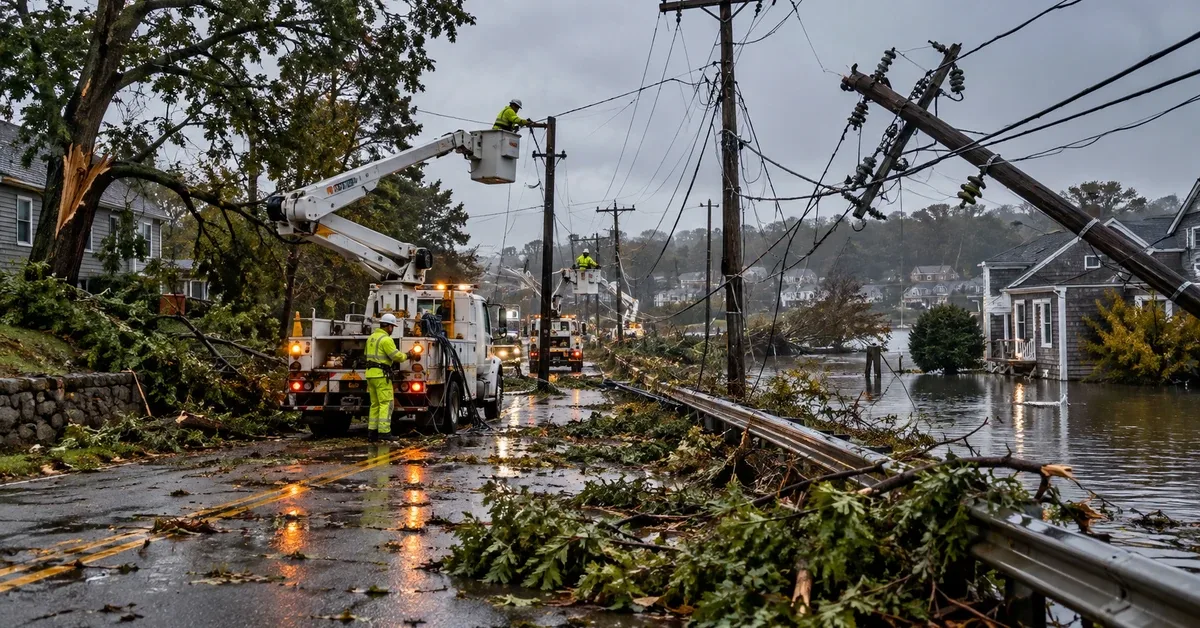
A powerful nor’easter struck the northeastern United States over the weekend, bringing power outages, coastal flooding and major transport disruption. Reuters reported that more than 100,000 homes and businesses lost electricity at one point on Saturday. By late evening, more than 73,000 customers were still without power across Connecticut, New York, Massachusetts, New Jersey, Rhode Island and Pennsylvania. New York and Connecticut were among the hardest-hit states, each with more than 20,000 customers still disconnected.
The slow-moving storm brought strong winds, heavy rain and unusually high coastal water levels. Roads flooded in several areas, trees came down and power lines were damaged. According to the Associated Press, an employee of the New York City Housing Authority was killed in Brooklyn by a falling tree. Emergency services, utility crews and road departments were dealing at the same time with flooding, blocked roads and damaged infrastructure.
Air travel was also heavily affected. Reuters counted 445 canceled flights and more than 3,000 delays involving U.S. airports on Saturday. States of emergency had already been declared in particularly vulnerable parts of New York and New Jersey. Connecticut activated its Emergency Operations Center. The National Weather Service warned that coastal flooding, strong wind gusts and heavy rain could continue through Monday.
The Hudson Valley showed how closely severe weather and electricity supply are connected. Central Hudson said more than 19,000 customers had been affected and that all 1,200 employees were working either in the field or in support roles. Fallen trees and branches complicated repairs. Additional outages remained possible while strong gusts continued. Other utilities also mobilized extra line workers and vegetation crews.
The event is especially instructive for blackout preparedness because no single technical defect caused the disruption. Wind, water, fallen trees, damaged lines and blocked roads occurred at the same time. Repairs can therefore take longer even when enough workers are available. A power pole cannot be repaired safely if the access road is flooded or more trees may still fall.
For households, the lesson is clear: when a severe storm is forecast, preparations should be completed before the wind and flooding arrive. Charge devices, keep drinking water and simple food available, test flashlights and save important information offline. It is equally important to avoid unnecessary trips and never enter closed or flooded areas.
Extra caution is required after the storm. Power lines may be hidden under branches or difficult to see in standing water. Utilities advise treating every downed line as energized and keeping well away. Even calm-looking floodwater can hide an electrical hazard.
The nor’easter therefore illustrates a typical compound emergency: power failure, flooding and transport disruption happen together and make each other worse. Blackout planning should not focus only on indoor lighting, but also on safe routes, water, communications and conditions outside the home.
The situation is particularly critical for people who depend on medical devices or have limited mobility. Anyone relying on powered breathing equipment, refrigerated medication or an elevator should clarify backup options and emergency contacts before severe weather arrives. When roads remain blocked for longer periods, help may take longer to arrive than under normal conditions.
Updated: 27 September 2026. Sources: Reuters, Associated Press, Central Hudson and the National Weather Service.
Latest updates
General
27.09.2026
US Northeast nor’easter: more than 100,000 customers lost power
US Northeast nor’easter: more than 100,000 customers lost power.