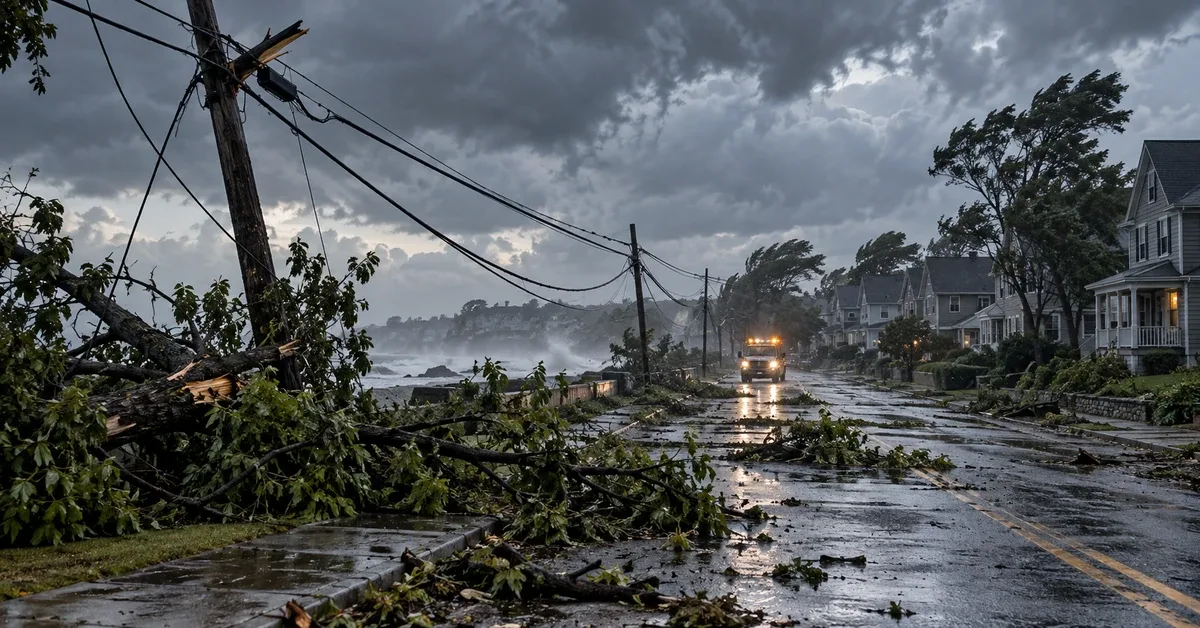
A powerful, slow-moving nor’easter struck the northeastern coast of the United States from New Jersey to New England on Sunday, 27 September 2026. The storm brought strong winds, persistent rain, dangerous surf and repeated high-tide flooding. According to PowerOutage.us, more than 130,000 electricity customers across the Northeast and Mid-Atlantic were without power on Sunday morning, according to Associated Press citing PowerOutage.us. The largest concentrations of outages were reported in coastal counties from New Jersey to Connecticut and on Long Island.
The combination of saturated ground and strong wind gusts brought trees and branches down onto power lines. On Long Island, homes were damaged and utility poles were knocked down. At the same time, the sea pushed water into low-lying coastal communities. In Sea Bright, New Jersey, each high tide brought fresh flooding. Parts of New Jersey had received more than four inches, or around ten centimetres, of rain since Friday. High tides made the situation worse and complicated both access to buildings and repair work.
The storm affected more than electricity supplies. Numerous flights along the East Coast were cancelled or delayed. More than 250 flights had been cancelled at Boston Logan International Airport by late Sunday morning while wind gusts reached about 40 mph, or 64 km/h. The National Weather Service expected the system to weaken overnight, although local officials warned that later high tides could still cause flooding.
For blackout preparedness, the event is instructive because the outages did not result from one single failure in the power system. Several pressures acted at the same time: wind damaged overhead lines, fallen trees blocked roads, floodwater restricted access to equipment and repair crews had to work in hazardous weather. Even when the wider transmission network remains stable, this kind of local damage can disconnect thousands of households for hours or longer.
Storm-related outages also create hazards beyond the loss of electricity itself. Fallen power lines may still be energised. Flooded basements or roads can conceal electrical dangers. Generators must never be operated in garages, basements or other enclosed areas because carbon monoxide can build up rapidly. Mobile service, internet, refrigeration, electric gates, pumps and medical equipment may also fail or depend on batteries.
For households, severe-weather warnings provide valuable preparation time. Mobile phones and power banks should be charged before the storm, torches should be kept within easy reach, and drinking water, medicines and shelf-stable food should be checked. People near overhead lines, large trees or flood-prone coasts should also choose a safer interior room and know how to receive official warnings without internet.
By Monday morning the effects were easing in many areas, but repairs were still continuing and some communities remained affected. The event shows that a blackout need not begin everywhere at once. A storm can create many separate local failures that are repaired step by step. For household preparedness, the key issue is therefore not only how likely an outage may be, but whether the household can safely manage for several hours or a few days without normal grid power.
Even after electricity returns, damaged wiring, wet electrical appliances and flooded installations should be inspected only by qualified professionals.
Sources: Associated Press, PowerOutage.us and the National Weather Service. Information current as of 28 September 2026.
Latest updates
General
28.09.2026
Nor’easter: More than 130,000 power outages across the US Northeast
A slow-moving nor’easter caused flooding, storm damage and more than 130,000 power outages from New Jersey to New England.