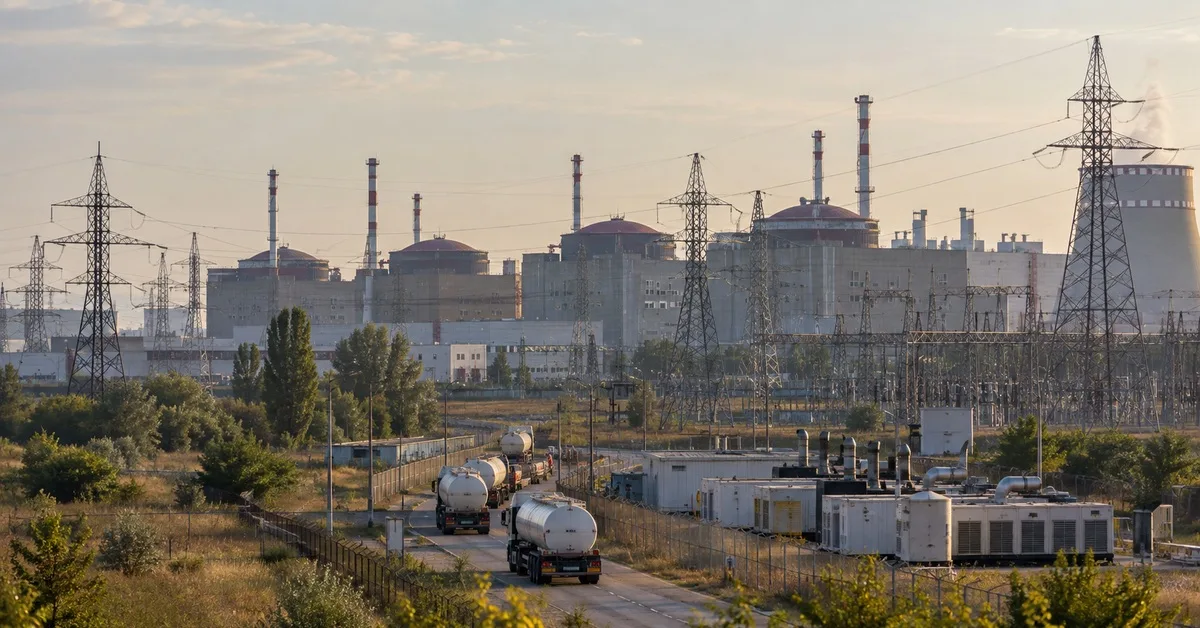
Reuters reported a new safety-related development around the Russian-controlled Zaporizhzhia nuclear power plant in Ukraine on 13 September 2026. Alexei Likhachev, head of Russia's state nuclear company Rosatom, accused Ukraine of attacking two diesel fuel trucks near the plant. He said two Russian servicemen were killed and others were injured. Ukraine had not commented on that specific allegation at the time of the report. The incident therefore has to be described as a Russian accusation rather than an independently verified fact.
The blackout relevance comes from the role diesel fuel plays in nuclear safety. Zaporizhzhia currently generates no electricity and all six reactors are shut down. Even so, reactors and spent fuel still require electricity for cooling, pumps, monitoring and other safety systems. If external grid power is lost, emergency diesel generators provide that essential electricity.
That scenario occurred again only weeks ago. The plant lost its last available external power connection on 20 August. It then relied on emergency diesel generators for more than two weeks. The International Atomic Energy Agency warned in late August that fuel reserves were under increasing pressure. To conserve diesel, the number of operating generators was reduced and some cooling functions were operated intermittently.
A local ceasefire brokered by the IAEA took effect in early September so that a damaged 330-kilovolt power line could be repaired. External electricity was restored on 7 September, ending the plant's immediate dependence on the diesel generators. The generators nevertheless remain a critical backup if the line is lost again.
The allegation reported on 13 September highlights another weak point. Backup power depends not only on the generator itself but also on fuel storage, transport routes and delivery vehicles. If a facility remains separated from the grid for an extended period, diesel logistics become part of the safety system.
Careful wording is important. There is no report that the plant is currently without electricity. There is also no confirmed report of a radioactive release or a nuclear accident connected with this incident. External power had been restored. The current story concerns an alleged attack on fuel trucks and the resulting concern about the reliability of backup supplies.
For blackout preparedness, the broader lesson is simple: emergency power is a chain, not a single device. It requires an energy source, fuel or batteries, cables, chargers, spare parts and a way to replenish the reserve. If one link fails, the entire backup arrangement can lose much of its value.
Households should not read this as a reason to fear an immediate nuclear accident. A more useful response is to examine their own backup chain. A power station without its charging cable, a generator without a reliable and lawful fuel plan, or a flashlight without the correct batteries can all become useless at the wrong moment.
Zaporizhzhia is an extreme example of a general problem in emergency energy planning: redundancy works only if the logistics behind the backup work as well. Sources: Reuters, 13 September 2026; IAEA background information and reporting on the restoration of external power in early September 2026.
Latest updates
General
14.09.2026
Zaporizhzhia: alleged attack on diesel trucks highlights backup-power logistics
Rosatom accuses Ukraine of attacking diesel trucks near Zaporizhzhia. The allegation is not independently verified, but it highlights how critical fuel logistics are to backup power.