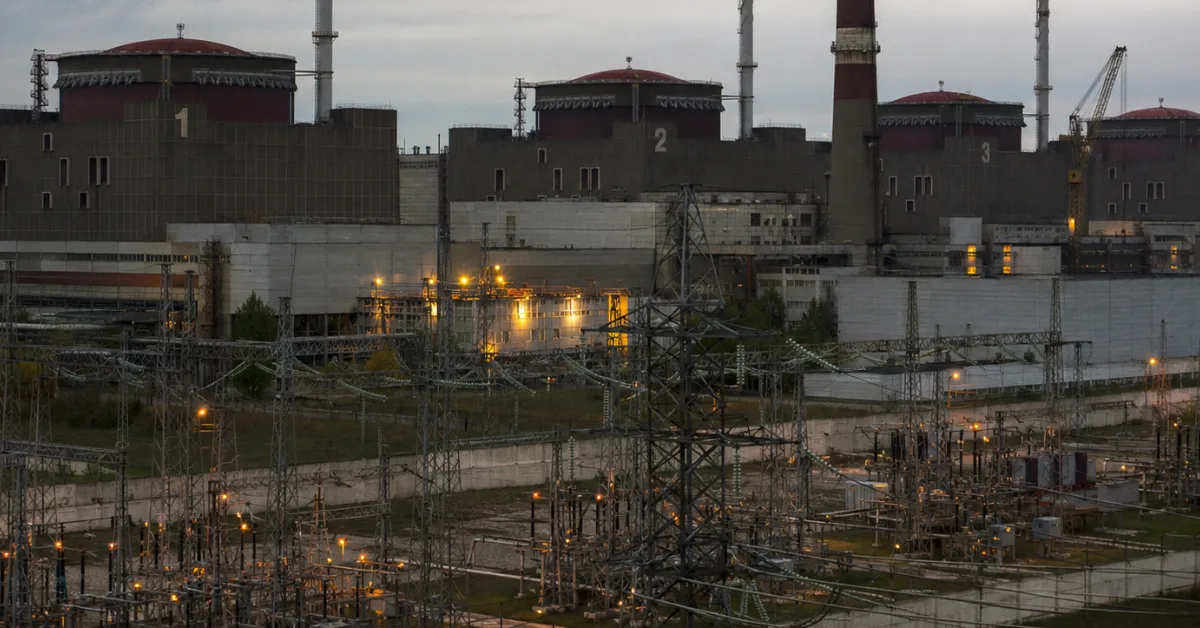
A power failure at a nuclear power plant is already a serious event. But when Europe’s largest nuclear power station loses its external electricity supply twice within only a few hours, a technical fault becomes a story of particular concern. That is exactly what happened on Saturday, 8 August 2026, at Ukraine’s Zaporizhzhia Nuclear Power Plant.
According to Ukrainian nuclear operator Energoatom, the 330-kilovolt L-243 “Ferosplavna – ZTPP No. 1” power line was briefly disconnected at 10:59. This line supplies important internal systems at the plant. Although the line automatically reclosed at the Ferosplavna substation and remained energised, the plant had to supply its own systems from diesel generators while the necessary switching and control procedures were carried out.
External power was restored at 11:52. The relief did not last long. At 14:26, the plant again lost its external electricity supply. Once more, diesel generators had to take over. Only at 15:35 were the plant’s internal needs supplied again through the 330-kilovolt “Ferosplavna-1” line.
The plant therefore had to rely on emergency power twice on the same day. According to information published so far, no radiological incident was reported. Even so, the situation is far from routine. The Zaporizhzhia plant has six reactor units and is regarded as Europe’s largest nuclear power plant. The reactors are shut down, but shutdown reactors still require electricity for cooling, monitoring and other safety-related systems.
The events are also part of a long series of problems affecting the site’s electricity connections. On 4 August, according to Ukrainian reports, the plant had already temporarily lost external power and had to rely on diesel generators. The IAEA has warned for years that reliable off-site electricity remains crucial for the safety of the site. Because the plant is not producing electricity normally, it is easy to assume that a power failure there is less serious. In reality, essential safety functions continue to depend on energy even while the reactors are shut down.
This is precisely where the danger of a prolonged blackout lies. Diesel generators are intended as a fallback, not as the permanent normal power supply for a nuclear facility. They must start reliably, have enough fuel and remain technically operational. The more often a plant depends on such emergency systems, the clearer it becomes how important several independent external power connections are for nuclear safety.
Energoatom said the renewed interruptions demonstrated the vulnerability of the plant under Russian occupation. The facility has been under Russian control since 2022. Statements about the causes of individual failures and responsibility must be assessed particularly carefully because the war is ongoing. What is not disputed, however, is that repeated losses of external electricity increase the safety risk.
For blackout preparedness, the incident offers a powerful reminder: emergency power is not the same as a permanently secure electricity supply. Even large critical facilities plan several fallback levels. The same principle applies on a smaller scale at home – a torch plus spare batteries, a power bank plus an alternative charging option, and more than just one way to provide light, communication or cooking.
The fallback system worked at Zaporizhzhia on Saturday. The fact that it was needed twice within only a few hours still makes the incident remarkable.
Sources: Energoatom, as reported by Ukrainian National News (UNN), 8 August 2026; Chornobyl.in.ua, 9 August 2026; International Atomic Energy Agency (IAEA), information on the importance of off-site and emergency power at the Zaporizhzhia Nuclear Power Plant.
Incidents & analysis
General
09.08.2026
Two blackouts at Europe’s largest nuclear plant: Zaporizhzhia switches to diesel
Europe’s largest nuclear power plant lost external electricity twice within hours on 8 August. Both times, diesel generators had to take over.