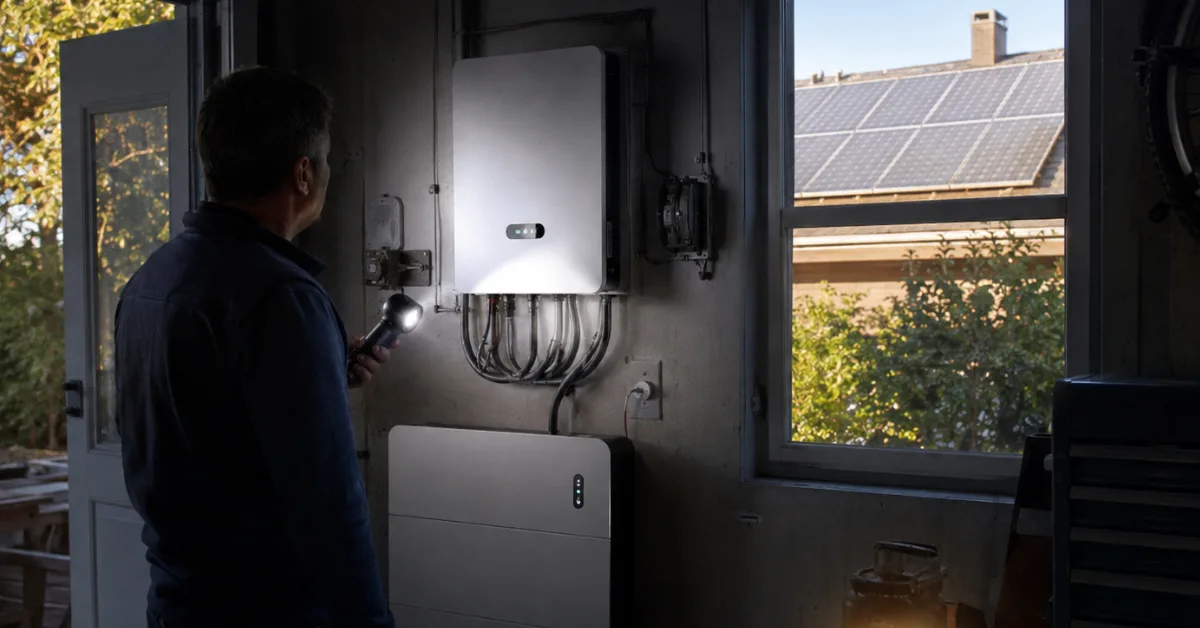
Many solar owners assume they will automatically have electricity during a grid outage. After all, the sun may still be shining and the panels are still capable of producing energy. In reality, a standard grid-connected photovoltaic system normally shuts down when the public network fails.
The reason is grid protection. The inverter constantly monitors the voltage and frequency of the electricity network. If the grid disappears, the system must stop feeding electricity into power lines where engineers may already be working. The inverter therefore disconnects from the grid and the solar system usually cannot supply usable electricity to the home.
To use solar power during a blackout, the system must be specifically designed for backup operation. Depending on the equipment, this may be described as backup power, emergency power or island mode. These terms are not always identical. Some systems provide only one dedicated emergency socket, while others can supply selected circuits or much of the house.
A battery alone does not automatically guarantee power during an outage either. Many batteries are designed simply to store solar energy for later use while the public grid is operating normally. Whether that stored energy is available during a blackout depends on the inverter, control system, transfer equipment and electrical installation.
Check what your system can actually do before an outage occurs. Look in the documentation for terms such as backup, emergency power supply, EPS or island mode. Better still, test the feature with the installer. You should know exactly which sockets and appliances receive electricity when the grid is down.
For backup operation, define the loads that really matter. A refrigerator, freezer, a few lights, router, phone chargers and perhaps a water pump are often more useful than an electric cooker, water heater, oven or large air-conditioning unit. High-power appliances can overwhelm a small backup output or drain a battery very quickly.
Safe electrical switching is essential. Never try to power a house by feeding electricity backwards through an improvised cable or wall socket. Such arrangements can place dangerous voltage on utility lines, damage equipment and endanger engineers. A genuine backup system must be properly designed and installed.
Even a correctly configured solar backup system does not provide unlimited energy. Batteries eventually run down, solar panels produce nothing at night and poor weather reduces generation. Plan for a small, controlled emergency load rather than normal household consumption.
Solar can be a major advantage during a blackout, but only when the installation is technically prepared for it. The important question should be answered before the outage happens: Do you know exactly what your solar system will do when the public grid suddenly disappears?
Guides
General
22.08.2026
Solar power during a blackout: Why your panels may suddenly stop supplying electricity
The sun is shining and solar panels are on the roof, yet the house is dark. What matters is whether the system supports genuine backup power or island operation.