A small power station, inverter or battery can feel like a reassuring backup. During a blackout, however, stored energy alone does not decide how long that backup will last. What matters just as much is which appliances you connect and in what order. Without a plan, high-power devices can drain a battery quickly and leave no electricity for tasks that later become genuinely important.
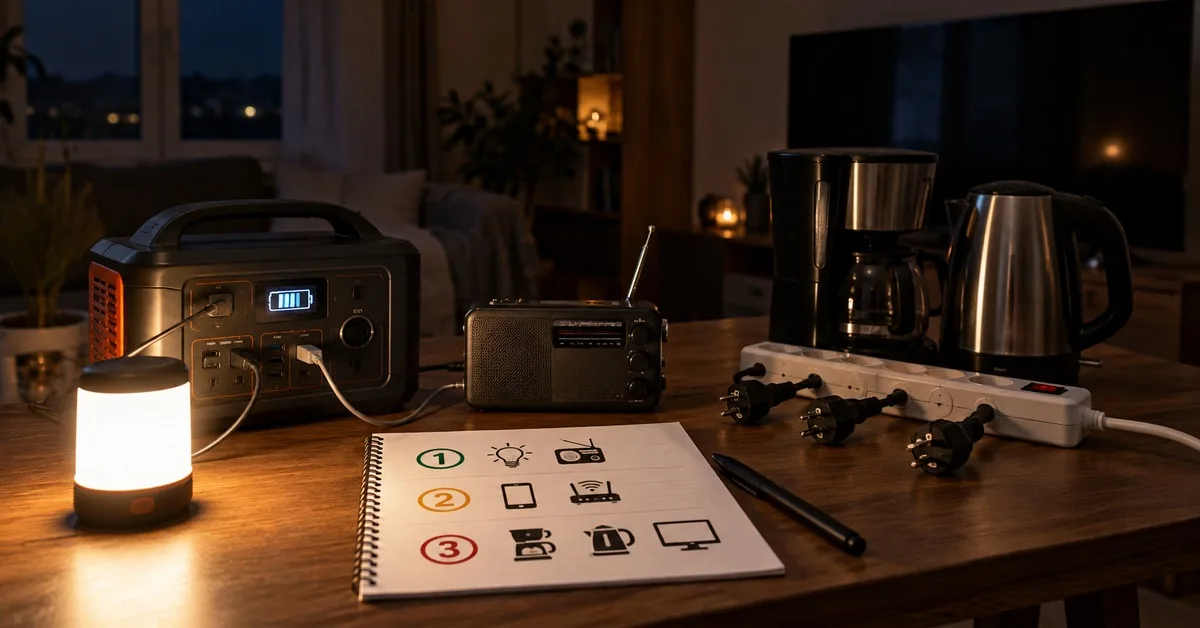
Use a three-level priority list. Level one contains equipment required for safety, health or basic needs. That may include medically necessary devices, essential communications, an efficient LED lamp, possibly a refrigerator and, depending on the home, a small water pump. These loads receive power first.
Level two contains useful devices that do not need to run continuously. Examples include smartphones, radios, laptops, routers and additional lighting. They should be charged or operated deliberately and for limited periods. A router need not run all day if the wider internet is down. A phone in power-saving mode can remain useful much longer when charged in short windows.
Level three contains comfort appliances with high power demand. Kettles, coffee makers, hair dryers, fan heaters, microwaves, toasters and electric hotplates can draw very large amounts of power. Many require 1,000 to 2,000 watts or more.
Write down the wattage of your important appliances. It is normally printed on the rating label or power supply. Multiply watts by operating hours to estimate consumption in watt-hours. A 50-watt device running for four hours uses roughly 200 watt-hours. A 1,500-watt kettle operating for ten minutes uses about 250 watt-hours. That comparison immediately shows why priorities matter.
Remember conversion losses. A power station cannot deliver every stated watt-hour perfectly to every outlet. Inverters, cables, temperature and internal electronics all consume energy. Do not plan to use the final watt-hour.
A refrigerator is a special case. Its compressor cycles instead of drawing full power continuously. Keep the door closed as much as possible. During a longer outage, operating it in intervals may be more sensible than powering many other devices at the same time. Food safety depends on the refrigerator, ambient temperature and how often the door is opened.
Charging order also matters. If grid electricity returns only temporarily or solar charging is available, refill the most important storage first. Not every power bank needs to be charged at once. Start with the main power station, the phone used for communication and batteries needed for lighting. Less important devices come later.
Write the three levels on paper and keep the sheet with your emergency power equipment. During a blackout you do not want to start calculating or arguing. A clear order saves energy and prevents impulsive choices. In a household, everyone should know which appliances may be used freely and which require agreement.
Test the plan once under normal conditions. You do not need to shut off the whole house. Simply simulate emergency operation for two or three hours and use only the devices on your list. Watch how quickly the battery percentage falls. That shows whether your assumptions are realistic.
A backup battery does not become larger because it was expensive. It lasts longer when it is used deliberately. The easiest rule to remember is: safety first, communication second, comfort last.
Guides
General
10.09.2026
Use backup power wisely: the three-level priority list for batteries and power stations
A power station will not last long if high-wattage appliances drain it. Three priority levels preserve energy for safety, communication and genuinely essential loads.