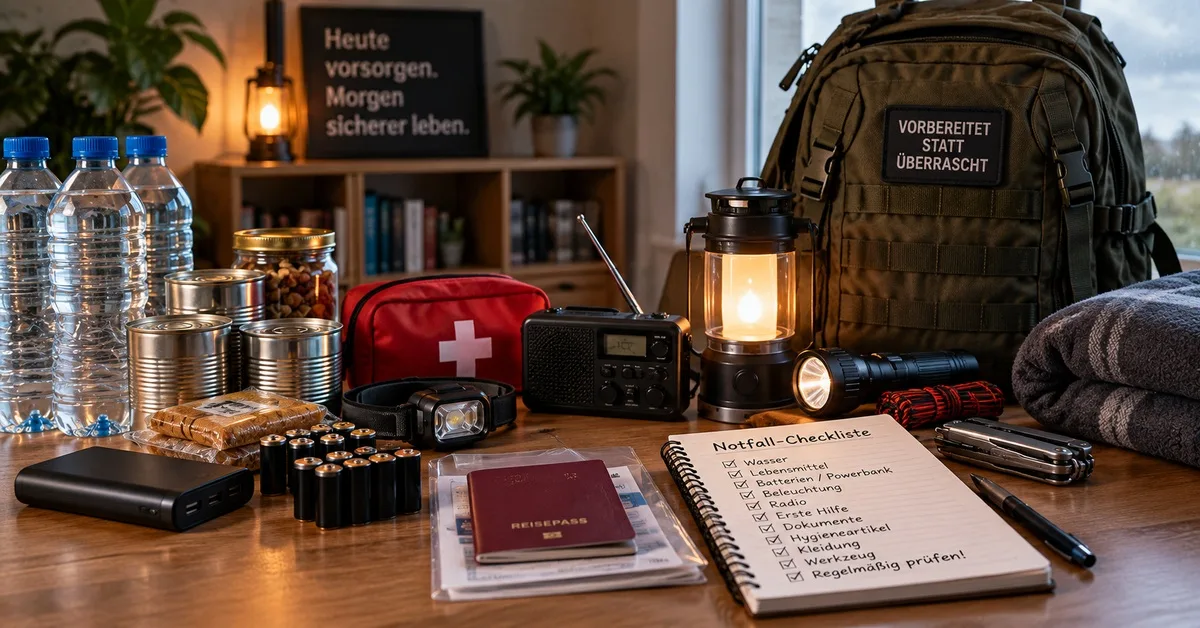
Blackout preparedness is often counted in items: three power banks, twelve batteries, two torches and a solar panel. That sounds organised but it does not answer the most important question: how many hours will your essential devices actually run? You should know that runtime before the electricity fails.
Start with a short priority list. Include only devices that genuinely matter during a prolonged outage. Typical examples are a smartphone, battery radio, headlamp, torch, a router with backup power, small medical equipment or a dedicated communications device. Televisions, game consoles and comfort electronics do not belong in the first priority group.
Next, test every power source under real conditions. Fully charge a power bank, connect the exact device you expect to use and record the start time, charge level and end time. For lamps, measure how many hours they run at a useful brightness. For radios, test at normal volume. Manufacturer specifications are useful, but they do not replace your own practical test.
Do not perform the measurement only once. Batteries age, capacity falls, temperature changes performance and some devices consume more after software updates. A test every six to twelve months is enough for many households. Power banks that swell, become unusually hot or are damaged should no longer be part of emergency equipment.
Then create a simple runtime sheet. One line per device is enough. Record the device, power source, tested runtime, last test date and priority. During a real outage you can immediately decide which reserve is used for what. That prevents wasting energy in the first hours and discovering later that essential communication has no power.
A second number is particularly useful: how many hours per day do you truly need the device? A smartphone does not need to remain active continuously during a blackout. If you switch it on briefly every two hours, check messages and return it to power-saving mode, the same power bank may last much longer. The same principle applies to radios and lighting.
Medical devices require extra caution. Do not rely only on self-calculated battery runtimes. Discuss backup power, spare batteries and possible alternatives with the manufacturer, doctor or service provider. Life-supporting equipment needs a robust emergency plan that does not depend on a single consumer power bank.
Solar chargers and small panels can extend your reserve, but output depends heavily on weather, orientation, season and shade. Test these systems as well. Do not merely check whether a panel charges; measure how much usable energy it can realistically replace during a typical day.
The goal is not a perfect energy calculation. You only need a reliable order of magnitude. If you know that your main lamp lasts 18 hours, your radio 30 hours and your phone reserve provides three full charges, you can plan much more calmly during a blackout. A collection of batteries then becomes a real backup-power plan.
Keep the runtime sheet with the emergency equipment and also save an offline photo on the phone. It remains available even if internet access and cloud storage are unavailable. Label chargers and cables clearly. A full power bank is little help if the correct cable is missing or the necessary adapter has been left somewhere else.
Guides
General
06.09.2026
Know your backup runtime: measure how long your emergency energy really lasts
A full power bank sounds reassuring but says little about hours of service. A simple runtime sheet tells you which devices get priority and how long your reserve will last.