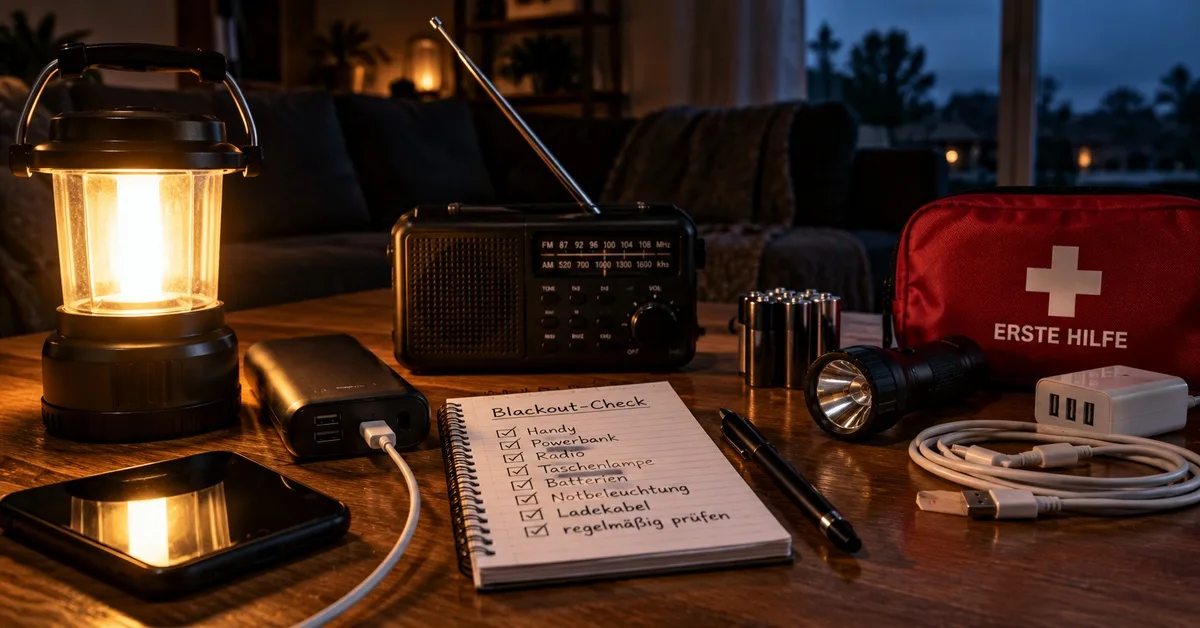
Many people buy flashlights, batteries, power banks and a radio for a blackout, place everything in a box and then leave it untouched for months. That creates an avoidable problem: when the outage finally arrives, a battery is empty, cells have leaked, the correct charging cable has disappeared or the radio no longer receives anything. A short functionality check prevents those surprises.
Choose a fixed appointment, for example the first Sunday of every month. The check should take no more than ten minutes. Keeping it short makes the routine realistic and easier to maintain. Put the most important devices on one table and always work through them in the same order.
Start with lighting. Switch on every flashlight, headlamp and LED lantern briefly. Test several brightness levels where available. Watch for flickering, loose switches or damaged battery compartments. Remove leaking cells immediately and dispose of them according to local rules. For indoor use, LED lights are safer than open flames and should be the main source of emergency lighting.
Next come power banks and rechargeable batteries. Check their charge and bring them back to the standby level you have chosen. For devices that should not remain at one hundred percent during long storage, follow the manufacturer’s instructions. Do not rely only on the display: connect a phone or another small device briefly and confirm that the power bank actually delivers power. Also check that the correct cable is present and undamaged.
The radio is the next item. Switch it on, tune to a known station and check the speaker, volume control and battery compartment. If the radio offers several energy sources, regularly test at least the functions you intend to rely on in an emergency. A device that works only in theory but has never been tested in practice is not a dependable part of the plan.
Then inspect spare batteries. Store them dry, clean and preferably in their original packaging or a suitable battery case. Do not mix old and new cells in one device. Check expiry or best-before information, but do not rely on dates alone. Damaged, swollen or corroded batteries should be removed from the emergency supply.
The ten-minute check should also include accessories. Are charging cables, adapters and replacement lamps where they belong? Is emergency lighting stored where you can find it in darkness? A flashlight in a basement is of little use if the fuse box is on another floor and you first have to cross a dark staircase. At least one working lamp should have a fixed, easily reachable location.
Record the check with a date on a small card or in an offline note. You do not need a complicated spreadsheet. A tick beside light, radio, power bank, batteries and cables is enough. If something is missing, replace or repair it immediately rather than leaving it for “later.”
This routine becomes especially valuable when outages happen repeatedly. After a long interruption, batteries are used, cables are moved and devices may be left partly discharged. Before the next event, the emergency equipment is therefore not automatically ready again.
Ten minutes a month does not replace full blackout preparedness. It does make sure that the technology you plan to depend on works. Preparedness is not only owning equipment; it is verifying it.
Guides
General
09.09.2026
The 10-minute blackout check: test every month whether your emergency equipment really works
An emergency box is only as useful as its contents. A fixed 10-minute routine checks lights, radio, batteries, power banks and cables before the next outage begins.