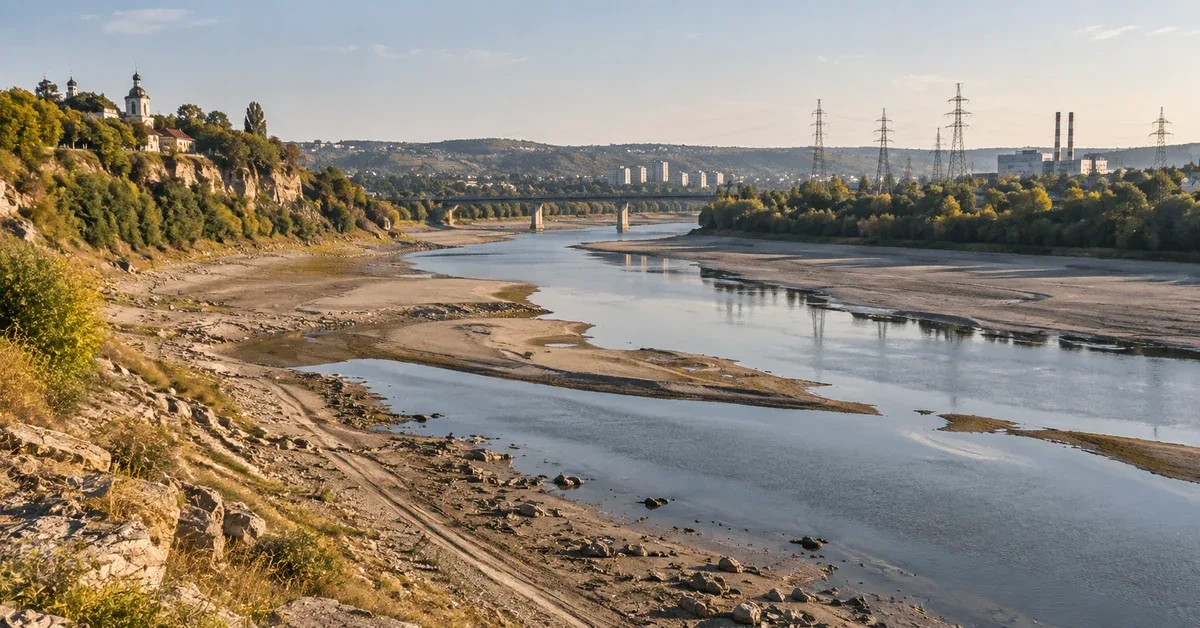
Moldova is preparing for a possible emergency affecting energy and water supplies. Following a meeting of the National Security Council on 21 September 2026, the government announced that it would ask parliament to declare a state of emergency in the energy and water sectors. The move reflects simultaneous risks to energy security and exceptionally low levels on the Dniester River, which Moldova shares with Ukraine. Parliament is due to consider the request at an extraordinary sitting on 22 September.
According to Moldovan authorities, inflow into the Novodnistrovsk reservoir has fallen to a historic low. Between 11 and 20 September, average inflow was reported at only about 23 cubic metres per second, compared with a normal seasonal level of roughly 100 to 120 cubic metres per second. Low river flow is not only a water-supply problem. Hydropower and regional electricity production also depend on adequate water levels.
President Maia Sandu said after the Security Council meeting that Moldova must be ready for different scenarios and protect access to water, electricity, natural gas and fuel. Renewable generation has increased, she said, but capacity is still insufficient to cover peak demand. Prime Minister Vasile Tofan said the government wanted additional legal tools before existing risks developed into an acute crisis.
A distinction is that, at the time of the announcement, Moldova was not experiencing a nationwide electricity or water outage. The proposed emergency regime is preventive, responding to a difficult hydrological and energy situation. That distinction matters for blackout preparedness. A supply crisis does not always begin with a sudden grid collapse. Risk can build for weeks through drought, reduced generation reserves, dependence on imports or problems in neighbouring systems.
Moldova is interconnected with surrounding energy systems and imports a share of its electricity, gas and oil. Earlier this year, the loss of an important high-voltage connection following attacks on Ukrainian energy infrastructure demonstrated that vulnerability. Alternative interconnections and emergency measures were required to stabilise supply. During the same period, oil pollution in the Dniester following an attack on a Ukrainian hydropower plant temporarily affected water supplies in several Moldovan communities.
For households, the current situation illustrates why electricity and water preparedness should be planned together. Electric pumps, treatment equipment and pressure stations are part of modern water networks. In the other direction, water shortages can also affect electricity generation when hydropower output falls or power stations face cooling and operational restrictions. Two systems that appear separate in everyday life can become tightly linked during a crisis.
In practical terms, households should not wait for an outage before acting. Drinking water for several days, separate utility water for hygiene and toilet flushing, charged power banks, flashlights, essential medication and reliable official information provide a useful basic reserve. Anyone relying on electrically powered well pumps, domestic pressure systems or other pumping equipment should also know exactly what will and will not work during a power cut.
The proposed emergency does not mean Moldova is automatically on the verge of a blackout. It shows how authorities try to create room for action before shortages escalate. The same principle applies at home: preparing water, energy and communication while services are still operating reduces the need to improvise later.
Sources: Government and National Crisis Management Center of the Republic of Moldova; Moldpres; Reuters. Updated 22 September 2026.
Latest updates
General
22.09.2026
Moldova moves toward energy and water emergency as Dniester hits historic low
Moldova is preparing emergency powers for energy and water supply as exceptionally low Dniester flows increase supply risks.