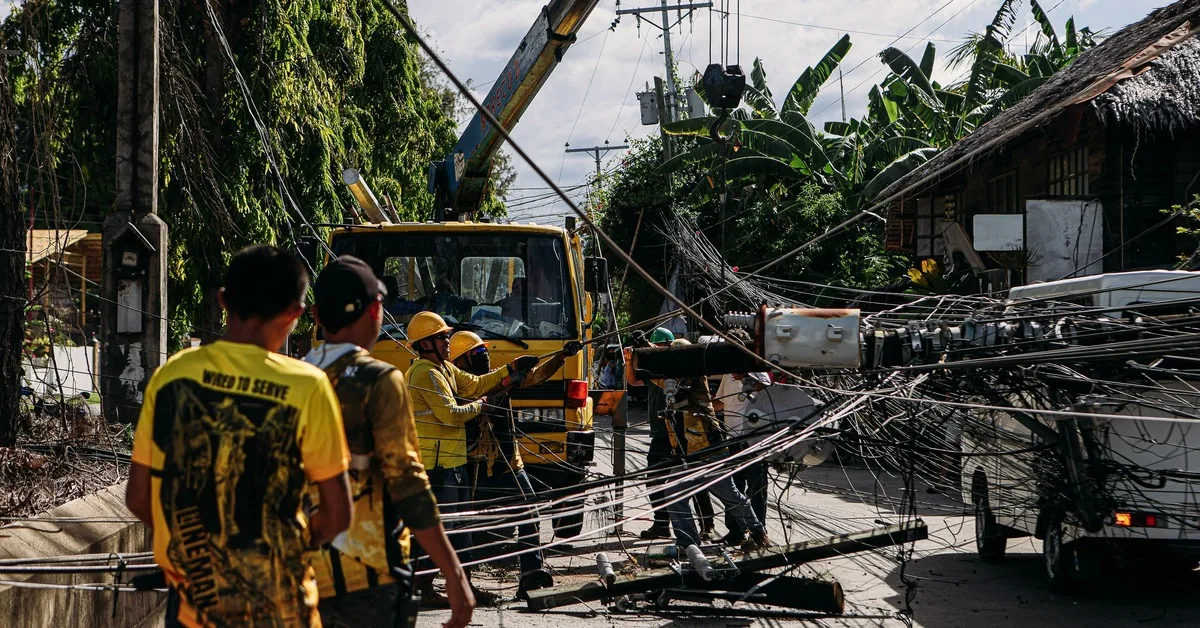
A severe storm triggered Latvia's largest power cuts in roughly 20 years during the night into Sunday, 23 August 2026. Distribution operator Sadales tīkls reported that nearly 277,000 customers were without electricity at about 7 a.m. The damage reached well beyond local distribution lines and affected major parts of the transmission system.
The storm intensified on Saturday evening. Around 108,000 customers had already lost power by 8 p.m., and the number continued to rise overnight. Strong winds, heavy rain and falling trees damaged lines and infrastructure across numerous regions. Eastern and southern parts of the country were among the hardest hit, although cuts were also reported around Riga and elsewhere.
Transmission system operator Augstsprieguma tīkls reported extensive technical damage on Sunday morning. Operations at 46 of more than 150 substations were disrupted. Five 330-kilovolt overhead lines were damaged, while 44 lines at the 110-kilovolt level were affected. Three of those 110-kV lines had already been restored by morning.
The operator's incident list recorded many additional faults overnight, including problems at substations in Sigulda, Ieriķi, Madona, Preiļi, Barkava, Viļāni and Ķegums. The number of simultaneous faults illustrates how a major storm can strike several levels of an electricity network at once.
Authorities had warned that wind gusts could reach roughly 25 to 32 metres per second. Under such conditions, trees and large branches can collapse onto overhead lines. Heavy rain also increases the risk of flooding around electrical equipment. Grid operators therefore moved to heightened readiness and prepared repair crews in advance.
Officials specifically warned people to stay away from downed power lines, trees hanging on conductors, flooded transformers and switchgear. Residents in threatened private buildings were advised to disconnect their electrical supply before rising water reached installations, but only when the main panel could be reached safely.
With damage spread across a large area, full restoration can take much longer than after an ordinary local fault. Some residents were told that repairs in their area could take more than 24 hours.
Latvia's storm demonstrates how quickly many individual line faults can develop into a broad electricity emergency. If high-voltage lines, substations and local networks are damaged simultaneously, operators must stabilise the system and return damaged sections to service in a controlled sequence.
For households, severe storms can therefore mean much more than a brief interruption. Charged phones and power banks, alternative lighting, drinking water and a plan for refrigeration and electrically dependent home systems become important when a power cut lasts many hours.
Sources: LETA via BB.LV, 23 August 2026; Augstsprieguma tīkls (AST), 22–23 August 2026; LSM, 22 August 2026.
https://en.bb.lv/article/our-latvia/2026/08/23/the-storm-caused-the-largest-power-outages-in-the-last-20-years-108005
https://ast.lv/lv/content/pieslegumi-parvades-sistemai
https://www.lsm.lv/raksts/zinas/latvija/22.08.2026-sestdienas-vetra-lietu-nomaina-vejs-aptuveni-160-000-majsaimniecibam-trauceta-elektroapgade.a659923/
Latest updates
General
23.08.2026
Latvia hit by worst power cuts in 20 years as storm cripples grid
A severe storm caused widespread damage to Latvia's power system. Nearly 277,000 customers were without electricity on Sunday morning as substations and high-voltage lines failed.