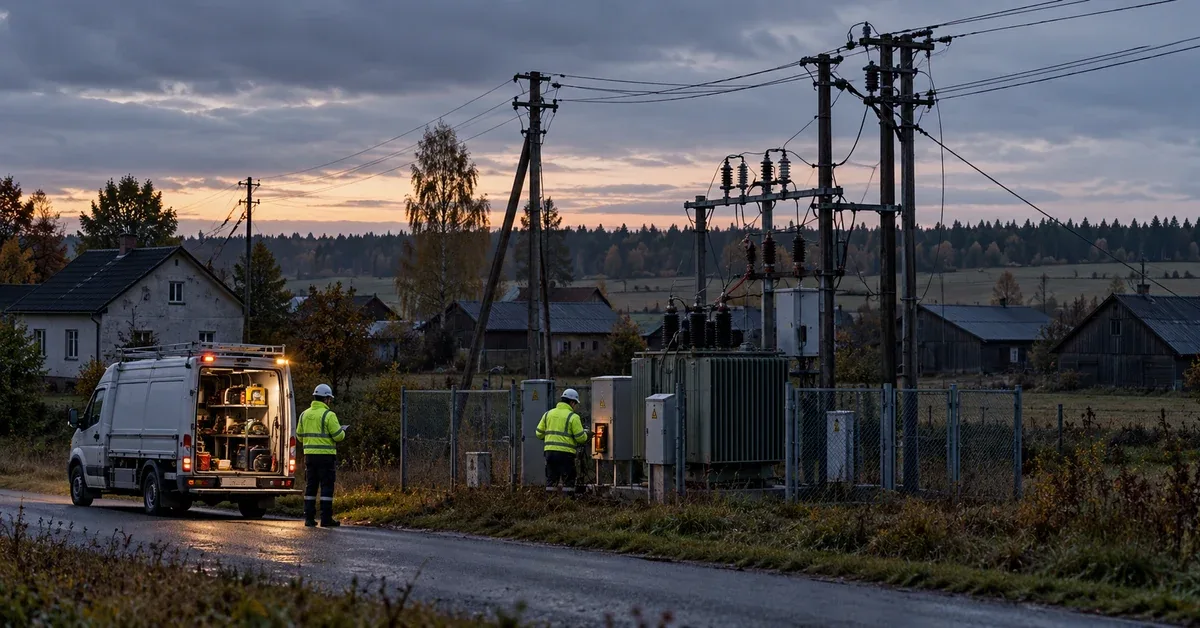
On Tuesday morning, 29 September 2026, a significant fault occurred in the electricity distribution network in Latvia’s Dobele municipality. According to distribution operator Sadales tīkls, around 2,600 customers lost electricity. The outage mainly affected areas around the parishes of Tērvete, Penkule and Naudīte. Company specialists immediately began locating the fault and working to restore supply. At the time of the first official reports, neither the exact cause nor a reliable estimate for full restoration had been published.
Compared with a nationwide blackout, the event appears limited, but that is exactly why it is relevant to preparedness. Local distribution faults are among the more realistic situations households may face. Several thousand connections can fail at the same time even while the national electricity system remains fundamentally stable. For the people affected, that technical distinction initially changes little: lights, routers, refrigerators, heating controls, pumps or electric gates can stop from one moment to the next.
According to Latvian media, Sadales tīkls initially published only the affected areas and the approximate number of customers. No further details about the damage were released. That is not unusual while technicians are still investigating. Grid operators first have to locate the fault, make damaged sections safe and determine whether parts of the network can be supplied through alternative routes. Only then is it often possible to provide a serious estimate of repair time. This first phase is difficult for residents because the outage is confirmed but there is still no dependable timetable. A small emergency setup that is already ready reduces the need to improvise under pressure.
The outage affected a region where electricity-network damage has already been an issue several times this year. The consequences of a storm on 22 and 23 August were particularly severe. Reports at the time said that almost 50 transmission lines and more than 40 substations were damaged, with the distribution network also affected. The current Dobele incident, by contrast, was initially reported as a single major grid fault. No connection with the August storm was stated.
Since September, Latvia has also had new rules for very long unplanned interruptions. If an outage lasts more than 72 hours, the distribution operator may in certain cases be required to compensate the customer. That does not mean such a duration was expected in Dobele. The rule does, however, underline that even comparatively robust networks must plan for situations in which restoration can take much longer than a few minutes.
For households, the most important lesson is therefore not the size of the fault but the lack of warning. Preparing for a local outage does not require complicated technology for the first hours: accessible torches, charged power banks, a radio, drinking water, essential medicines and a way to follow official updates from the grid operator are a solid basis. Refrigerators and freezers should remain closed as much as possible until the likely duration is clearer.
The Dobele outage is not evidence that Latvia faces an imminent nationwide blackout. It is a current example of how several communities can lose electricity at the same time while the cause and duration remain uncertain. That kind of uncertainty is exactly what practical blackout preparedness is designed to handle.
Sources: Sadales tīkls, Jauns.lv/LETA and Rīga TV. Information current as of 30 September 2026.
Latest updates
General
30.09.2026
Latvia: Around 2,600 customers lose power after major grid fault
A major distribution-grid fault in Dobele municipality left around 2,600 customers in Tērvete, Penkule and Naudīte without power. The cause and restoration time were initially unknown.