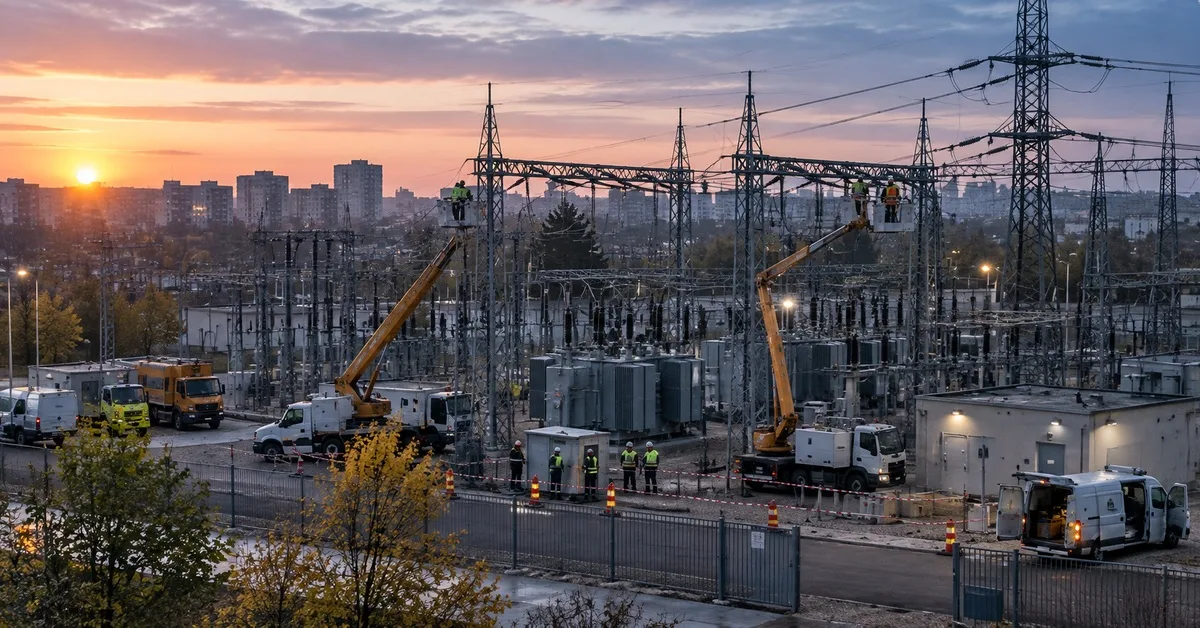
A substation accident in Kryvyi Rih, in Ukraine's Dnipropetrovsk region, caused a large power outage on September 16, 2026. According to regional military administration head Oleksandr Hanzha, more than 56,000 customer connections initially lost electricity. Repair crews began work immediately. By the evening, most consumers had been reconnected through backup supply schemes, while nearly 20,000 connections were receiving electricity only according to schedules.
The problem was not fully resolved the following day. Local reports citing DTEK Dnipro Grids said on September 17 that the disruption had already lasted for almost 20 hours. Large areas of the Saksahanskyi and Pokrovskyi districts were still affected. In this later update, DTEK referred to around 50,000 affected customers, about half of whom had been restored. Roughly 25,000 households were still without normal electricity supply, and temporary emergency outages were introduced.
The different figures — more than 56,000 connections on the first evening and around 50,000 customers in the later update — do not necessarily contradict each other. They come from different points in time and different sources while switching and repair work was continuing. What is clearly established is that the outage was large, restoration was gradual, and backup connections played an important role.
The cause also requires careful wording. Authorities described an accident or fault at a substation. The available reports do not provide evidence that an attack caused this particular incident. DTEK also said that the damaged energy facility did not belong to DTEK Dnipro Grids. In a wartime context, that distinction matters because a technical failure should not automatically be described as an attack.
The event illustrates why substations are critical nodes in an electricity network. They connect different voltage levels and distribute power across large urban areas. When one of these nodes fails, many households can lose electricity at the same time even though generating plants and other transmission lines remain operational. Backup schemes can restore part of the supply, but they may not have enough capacity to return every customer to normal service immediately.
For grid operators, restoration after a failure like this involves much more than simply switching a breaker back on. The damaged equipment must first be made safe. Customers are then rerouted through alternative network paths where possible. Only after loading, protection systems and voltage conditions are stable can normal network configuration be restored step by step. That is why one street can have electricity again while a neighboring area is still on a schedule or remains without supply.
The practical lesson for households is to determine whether an outage affects only one apartment, the entire building, the street or a wider network area. That information helps decide whether to check the household breaker panel, call an electrician or wait for information from the grid operator.
Kryvyi Rih also shows that a regional outage does not always end after a few minutes. Even when backup circuits work, individual districts can remain on restricted supply for many hours. Charged phones, independent lighting, drinking water, some cash and a clear plan for communication and refrigeration remain useful.
Sources: Dnipropetrovsk Regional Military Administration via Interfax-Ukraine and UNN, September 16, 2026; local reports citing DTEK on September 17, 2026.
Latest updates
General
17.09.2026
Ukraine: Kryvyi Rih substation accident leaves tens of thousands without power
More than 56,000 connections initially lost electricity after a substation accident. Local reports citing DTEK said around 25,000 households still lacked normal supply the following day.