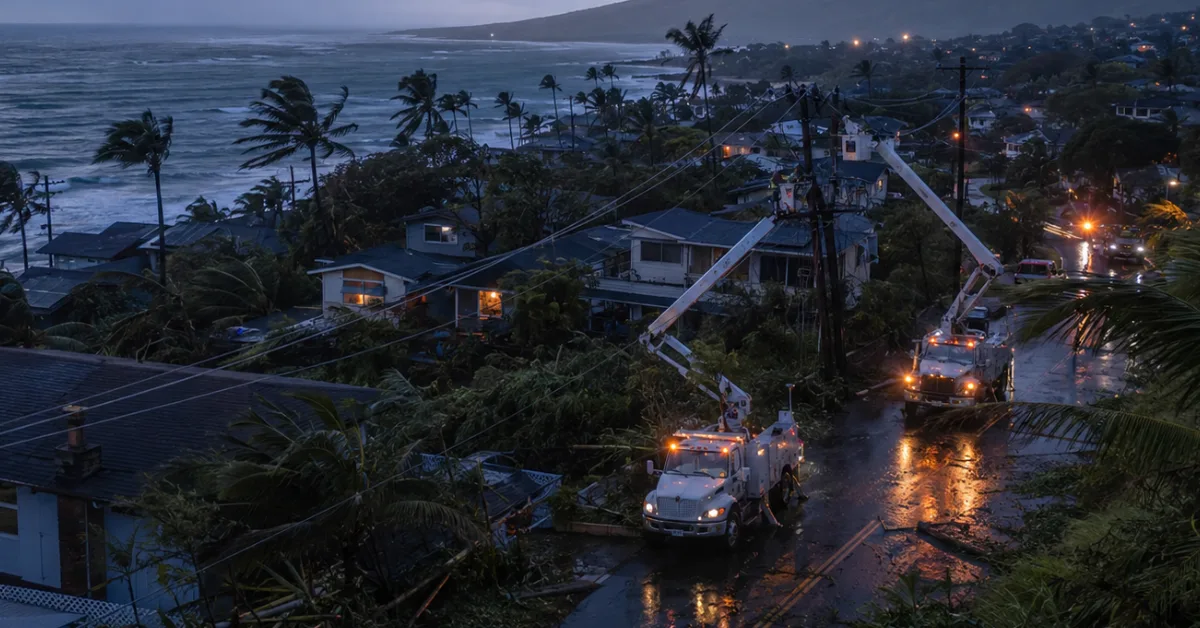
Hawaii is dealing with major damage to its electricity system after Tropical Storm Lala. On Sunday, August 16, 2026, strong winds and heavy rain swept across the island chain. Although the storm passed south of the islands, it still left flooded roads, fallen trees, damaged power lines and widespread outages across Oʻahu, Maui and Hawaiʻi Island.
The scale of the disruption became especially clear during the day. Hawaiian Electric reported more than 250,900 customers without power around midday Sunday. Although repair crews made rapid progress in many places and had already restored service to nearly 180,000 customers by the afternoon, around 178,400 connections were still without electricity at 7 p.m. About 126,500 of those were on Oʻahu, roughly 44,900 on Hawaiʻi Island and around 7,000 in Maui County.
The figures show how dynamic a large weather-related outage can be. While lines are re-energized in one area, wind, falling trees or unstable ground can cause new damage elsewhere. Hawaiian Electric therefore stressed that reported outage numbers represent only a snapshot in time.
Damage to major transmission lines is particularly serious. Several of these lines were affected by Lala on Hawaiʻi Island, Maui and Oʻahu. They form the backbone of the power system, connecting power plants and other generating sources with communities. Until important transmission links are restored, local distribution networks may not be able to return fully to normal.
Repairs are also being made harder by the terrain. Flooding, uprooted trees, mud, debris and unstable ground have made some areas difficult to reach. Some transmission routes cross remote or mountainous regions. Hawaiian Electric has therefore used helicopters and drones to inspect damage. In some locations, technicians may even have to hike to damaged infrastructure once weather and ground conditions allow.
On Hawaiʻi Island, three major transmission lines had been repaired by Sunday evening. Even so, tens of thousands of customers remained without electricity, especially in Puna, North Kona and South Kohala. Residents in the most heavily damaged rural areas were told to prepare for extended outages. Local authorities also reported destroyed bridges, road closures and downed utility lines that further complicate restoration work.
Oʻahu was also under significant pressure. The utility asked customers who still had electricity to reduce consumption. Residents were encouraged to limit air-conditioning use and delay hot showers, laundry, dishwashing and major cooking activities. The goal was to preserve enough available generation while the grid remained under strain.
Additional help is expected from the U.S. mainland. Hawaiian Electric requested skilled workers from other utilities through a mutual assistance network. Around 100 workers are expected to travel to Hawaii to support restoration efforts.
The event shows that natural disasters do not simply knock down individual poles. When transmission lines, roads and access routes are damaged at the same time, restoration can take much longer even when sufficient crews are available.
For households, the lesson is to prepare for more than a short outage. Drinking water, lighting, power banks, a battery radio, medicines and food should be planned so that several days without reliable grid power can be managed. Downed power lines must always be treated as potentially energized and should be avoided by a wide margin.
Sources: Hawaiian Electric, August 16, 2026; Big Island Now, August 16, 2026; Honolulu Civil Beat, August 16, 2026; Global News, August 16, 2026.
Latest updates
General
17.08.2026
Storm Lala hits Hawaii power grid: more than 250,000 customers lose power
Tropical Storm Lala damages transmission lines on Oʻahu, Maui and Hawaiʻi Island. More than 250,900 customers lose power as flooding and difficult terrain slow repairs.