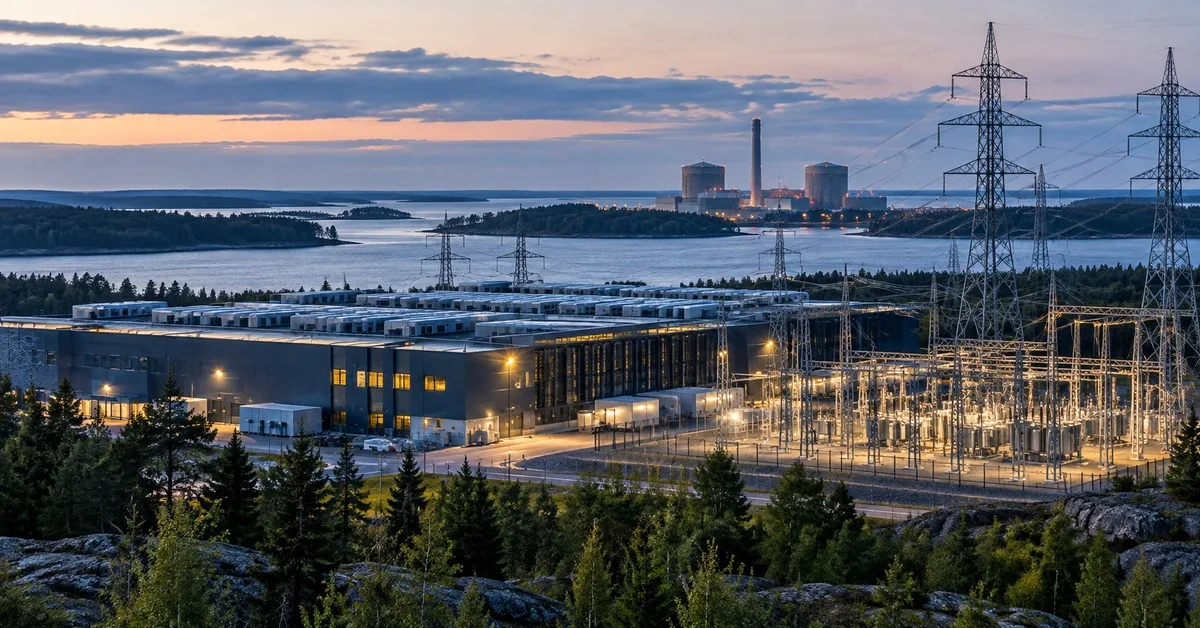
Finland’s electricity debate has gained a new dimension as artificial intelligence infrastructure expands rapidly. Reuters reported on 10 September 2026 that opposition parties are warning about possible pressure on electricity supply and transmission capacity after Google announced at least €13 billion of new AI investment in Finland. The project is Google’s largest European investment so far and includes long-term power arrangements.
Finland has become highly attractive for data centres. Its cool climate reduces cooling demand, the grid is considered reliable, and much of the country’s electricity is low carbon. Those advantages are now drawing much larger AI facilities. Data centres, however, consume substantial electricity continuously and require very high reliability. If many large projects arrive at the same time, generation, transmission networks and reserve capacity must expand accordingly.
A major part of the announcement is an agreement between Google and Finnish utility Fortum. Google could purchase up to 50 percent of the electricity output from the Loviisa nuclear power plant for 22 years. The arrangement helps extend the expected life of the plant to 2050. Google and Fortum also plan to explore additional nuclear and renewable energy development in Finland.
The Centre Party is therefore calling for a national permitting system for new data centres. Party leader Antti Kaikkonen told Reuters that no authority currently has sufficient responsibility for the overall picture of electricity demand and grid capacity. The Social Democratic Party has also argued that electricity availability and affordability should be treated as a broader internal security issue.
Prime Minister Petteri Orpo takes a more positive view. He expects the investment to support Finland’s economy and has said electricity prices will remain under control. There is therefore no official indication that Finland is facing imminent blackouts or forced power cuts. The dispute is about whether growth in major electricity users could move faster than new generation and transmission infrastructure.
For blackout preparedness, the discussion still matters. Power systems rarely come under pressure because of one factor alone. Rising demand can combine with delayed grid upgrades, power-plant outages, severe weather or limited imports. When reserve margins become smaller, an otherwise manageable disruption can have a larger effect.
Data centres are also different from many ordinary electricity users because they operate around the clock and cannot simply be switched off without affecting digital services. Operators therefore invest heavily in backup generators, batteries and redundant connections. For the public grid, however, the key question remains whether enough generation and transmission capacity exists for all users.
For households, this is not a reason for alarm. It is a reason to prepare calmly for several hours without grid electricity or reliable internet. Safe lighting, a radio, charged batteries, drinking water, some cash and important information stored offline can keep a household functional if a regional power problem also disrupts digital services.
Finland’s debate illustrates a modern energy challenge. Grid stress does not arise only from old power plants or extreme weather. Rapid growth in digital infrastructure changes where electricity is needed and how continuously it must be supplied. The crucial question is whether planning and grid expansion can keep pace.
Source: Reuters, 10 September 2026.
Latest updates
General
11.09.2026
Finland debates power strain from AI boom as Google invests €13 billion
Google’s largest European investment has put Finland’s electricity system into the political spotlight. Opposition parties warn about long-term pressure on generation, grids and prices, while no immediate blackout is indicated.