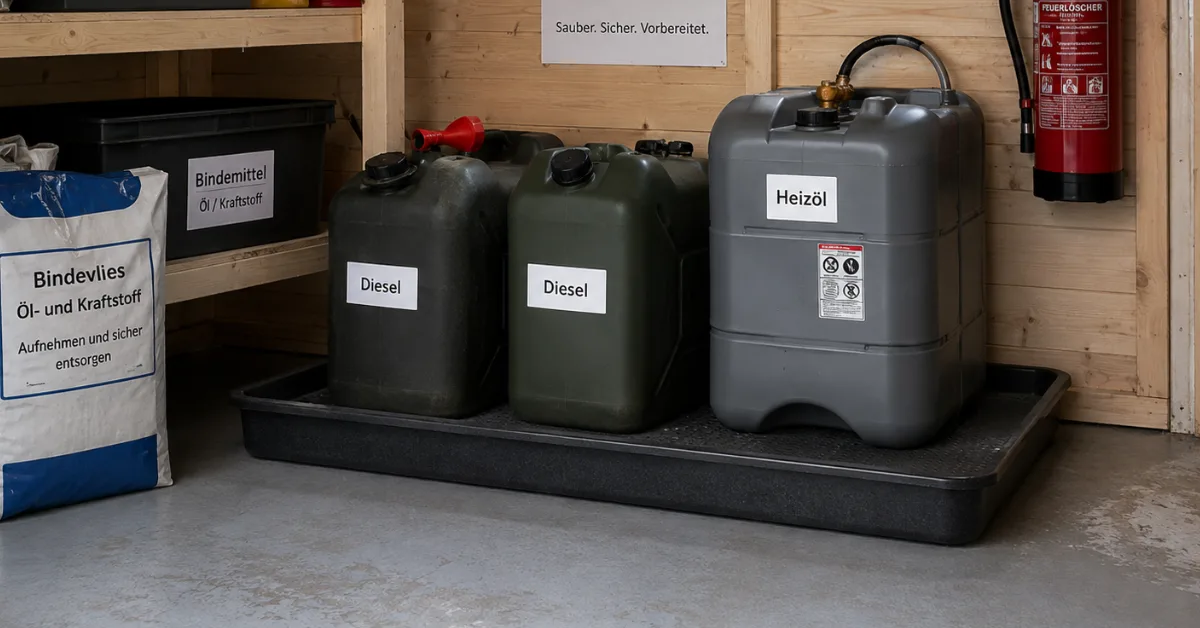
Diesel and heating oil can be valuable reserves during a prolonged blackout, for example for a suitable backup generator or a heating system. But a fuel reserve is useful only when it is stored safely. Leaking cans, unsuitable containers, heat, water in the fuel or a reserve forgotten for years can quickly turn preparedness into a fire, environmental or equipment problem.
The first question should therefore not be “How many litres do I need?” but “Where am I allowed to store them, and where can I store them safely?”. Permitted quantities and requirements vary by country, region, building and insurance policy. Store only quantities that are locally permitted and reasonable for your actual needs. Living rooms, bedrooms, escape routes and areas with open flames, sparks, heaters or strong direct sunlight are unsuitable.
Use only purpose-made, tightly closing, fuel-resistant cans or approved tanks. Drinks bottles, open buckets and old containers of unknown origin do not belong in a fuel store. Label every container clearly with its contents and the date it was put into storage. Diesel and heating oil should not automatically be treated as interchangeable: use only the fuel approved by the manufacturer for engines, heaters and generators and permitted by local rules.
The storage area should be cool, dry, protected from direct sunlight and arranged so that a leak cannot immediately reach soil, drains or waterways. For larger tanks, secondary containment, double-wall designs or other technical safeguards may be standard or legally required depending on local rules. Cans should stand securely and be protected against falling over, impacts and damage.
Diesel in particular does not automatically remain “good forever” in long-term storage. Moisture can enter tanks, water can collect at the bottom, and this can encourage microbial growth and fuel ageing. A rotated reserve is therefore better than a forgotten one: use the oldest fuel first, replace it regularly, and inspect containers for rust, deformation, leaking closures or unusual deposits. Larger tanks should be maintained professionally.
Do not store more fuel than necessary simply because a blackout could theoretically last a long time. Calculate your reserve from the equipment you genuinely intend to run and plan economical operating periods. A smaller reserve that is rotated regularly is usually more sensible than a large quantity left untouched for years. Fuel additives are not a licence for unlimited shelf life; use them only according to the manufacturer’s instructions.
Transferring fuel also needs a clear routine. Use suitable spouts or pumps, avoid spills and keep ignition sources away. Do not improvise by filling containers to the brim; follow the intended filling limit. Keep suitable absorbent material available for small leaks and dispose of contaminated material in accordance with local rules. Larger leaks should be handled by professionals.
Check the fuel reserve several times a year together with the rest of your blackout equipment. Are the quantities still appropriate? Are containers and closures undamaged? Is the storage area free of new ignition sources or easily combustible materials? Are the labels still readable? This short inspection helps prevent you from discovering, during an emergency, a can whose contents, age or condition nobody can identify.
The most important principle is simple: fuel is reserve energy, but it is also a hazardous substance. Good preparedness does not mean stacking as much diesel or heating oil as possible. It means safely keeping a legal, manageable and well-maintained reserve. That way, usable fuel is actually available during a blackout without the reserve itself becoming the biggest risk.
Sources: UK Health and Safety Executive (HSE), Storage of flammable liquids in containers and Safe use and handling of flammable liquids; Shell Commercial Fuels, guidance on fuel storage, moisture and diesel ageing.
Guides
General
10.08.2026
Store diesel and heating oil safely: keep the reserve from becoming the risk
Diesel or heating oil can be valuable during a blackout, but poor storage creates fire, environmental and equipment risks. Here is how to plan, rotate and inspect a fuel reserve safely.