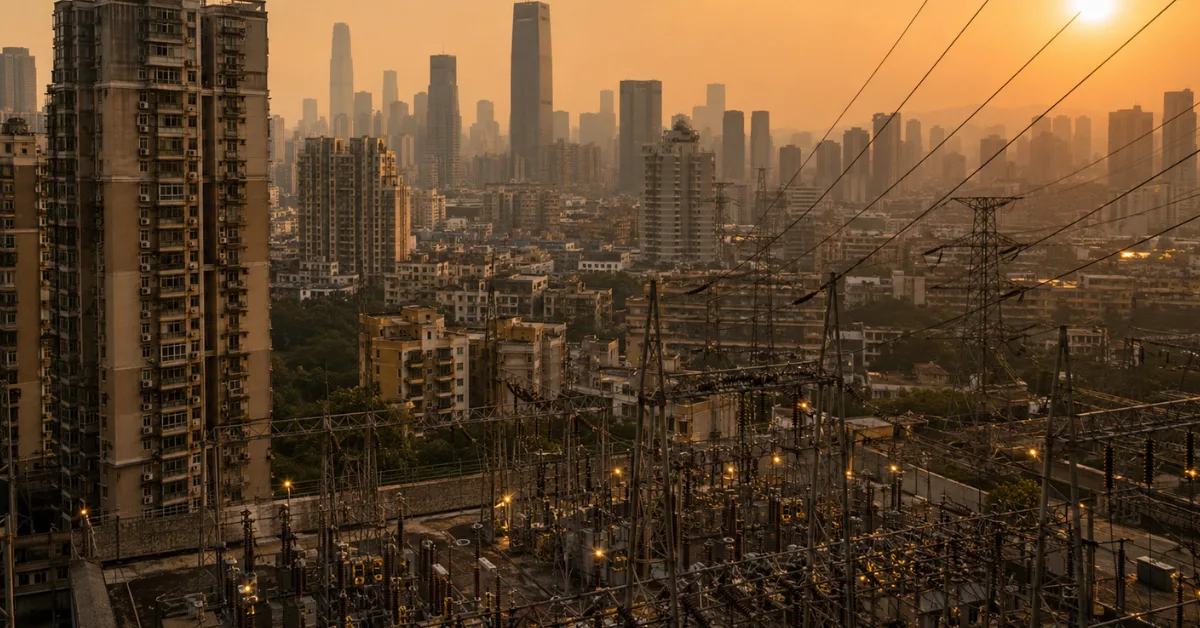
China is experiencing electricity demand that is extraordinary even for the world’s most energy-hungry country. A severe heatwave has pushed loads in northern, northeastern and eastern power grids to new records. Millions of air conditioners are running at the same time, factories continue to operate and data centres require electricity around the clock. No nationwide blackout has been reported, but the figures show how close extreme temperatures can bring modern power systems to their limits.
According to the State Grid Corporation of China, regional networks reached new peaks on Monday and Tuesday. Hebei, the port city of Tianjin, Liaoning and Shandong were among the areas particularly affected. Demand rose so quickly that the grid operator had to optimise operations and prepare additional transfers between regions. Electricity is to be moved towards the places where the heat is driving demand most sharply.
An especially clear signal came from the eastern province of Anhui. Peak demand there reached 69.99 million kilowatts on Tuesday, 2.1 per cent above the previous year. Authorities attributed the jump mainly to the heatwave. At the same time, new data centres, industrial facilities and other economic activity are raising the underlying level of consumption. The grid therefore has to absorb more than a brief weather spike while already operating at a higher baseline.
The south is also reaching levels that would have seemed difficult to imagine only a few years ago. Guangdong consumed more than 100 billion kilowatt-hours of electricity in a single month for the first time in July. At 100.798 billion kilowatt-hours, the economically powerful province became the first Chinese region to pass that threshold. Behind the figure are homes, tower blocks, factories, ports, cold chains and digital infrastructure that must all be supplied at once.
The weather forecast is making the situation more serious. Temperatures in parts of Liaoning and mountainous areas of northeastern China could approach or exceed historical extremes during the next ten days. The longer a heatwave lasts, the greater the risk becomes: power stations, transformers and lines operate under sustained load, while cooling technical equipment becomes more difficult. If a large generating unit or important transmission line then fails unexpectedly, reserves can shrink rapidly.
China has enormous generating capacity and a vast transmission network. That is exactly why the current records are so striking. Operators are responding with regional power exchanges, adjusted grid management and close monitoring. This does not mean that every local problem can be prevented. In a system carrying an exceptionally high load, small faults can develop larger consequences more quickly, especially when several disruptions occur together.
For the public, the situation is a warning rather than a reason for panic. Anyone who depends completely on air conditioning, electric cooking, lifts or water pumps during extreme heat should allow for short interruptions. Charged power banks, torches, drinking water, a battery radio and a plan for heat-sensitive people provide valuable reserves. Medicines and food that require refrigeration also need a simple emergency solution.
China’s demand record shows that a blackout does not begin only when a visible component breaks. Risk often builds silently beforehand: more air conditioning, more industry, more computing and less room in the grid. The systems are still holding. But when electricity use keeps setting records, every additional fault becomes a serious test.
Source: Reuters, 5 August 2026; State Grid Corporation of China.
Latest updates
General
05.08.2026
China at the power limit as heat drives grid demand to records
A severe heatwave has pushed electricity demand in several Chinese regions to historic highs. No nationwide blackout occurred, but reserves are under pressure.