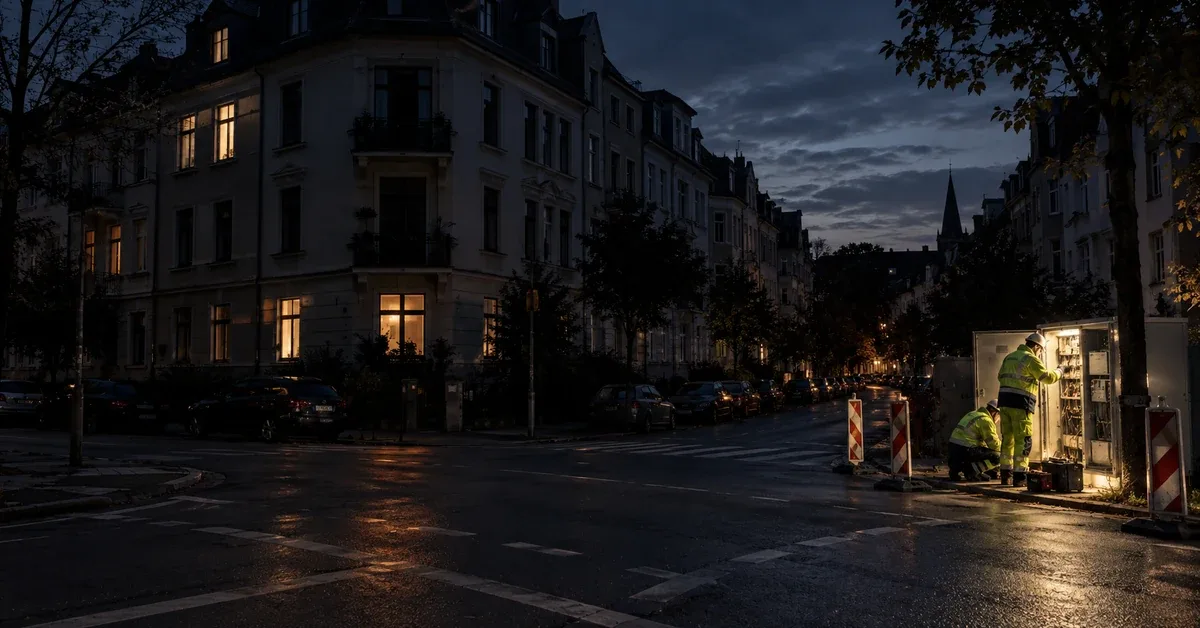
On Monday evening, 28 September 2026, a power outage affected several districts of Bonn in North Rhine-Westphalia, Germany. According to WDR, around 3,100 households lost electricity. The interruption affected Alt-Godesberg, Godesberg-Nord and Schweinheim. WDR’s Bonn studio also lost its normal electricity supply, meaning the regional programme “Lokalzeit aus Bonn” could not be broadcast as planned. Stadtwerke Bonn sent technicians to locate the fault. At the time of the first reports, neither the cause nor the expected duration of the outage had been established.
This initially uncertain situation is precisely what makes the incident relevant to blackout preparedness. A power failure does not have to affect an entire country to disrupt everyday life for many people at the same time. A local fault in the distribution grid can disable lighting, shops, traffic signals, lifts, routers, electrically operated garage doors and heating controls. Anyone preparing only for a spectacular nationwide blackout may overlook the much more common regional and urban outages. For those affected, the decisive question in the first minutes is not the geographical size of the event, but whether lighting, communication and essential equipment continue to work.
WDR and Tagesschau both reported about 3,100 affected households that evening and cited Stadtwerke Bonn as their source. The disruption became particularly visible because a media facility was also affected. This illustrates that even sites equipped with professional technology are not automatically immune to every local grid fault. Emergency power systems can protect critical functions, but they do not necessarily replace the normal electricity supply for every room, system and appliance in a building.
For private households, an outage of this kind is a useful reminder to think through the first two hours without grid electricity. A torch should be accessible without having to search for it in darkness. Mobile phones and power banks should be charged regularly. Anyone dependent on an electric door release, lift, water pump, medical device or electrically controlled heating system should know what actually continues to operate during a grid failure and what manual alternative is available.
Reliable information is equally important. During a local outage, neighbourhood rumours often spread faster than confirmed reports. A battery or hand-crank radio, stored telephone numbers for the grid operator and a plan for obtaining official information without Wi-Fi are therefore useful. At the same time, an outage should not be made harder to manage by unnecessary calls: emergency numbers must be reserved for genuine emergencies.
The Bonn incident is not evidence that a large-scale blackout is imminent. It is, however, a current example of how suddenly normal infrastructure can fail while the cause remains unknown at first. Preparedness is designed for exactly this uncertainty. Households that have light, communication, water, medicines and a simple action plan ready can manage the first hours calmly until the network operator has assessed the situation and restored the supply.
Preparing a household for these limited local disruptions also improves readiness for longer outages. Many of the practical measures are identical; only the amount of stored water, energy and other reserves must increase as the expected duration grows.
Sources: WDR, Tagesschau and Stadtwerke Bonn. Information current as of 29 September 2026.
Latest updates
General
29.09.2026
Bonn power outage affects around 3,100 households
Around 3,100 households in several Bonn districts lost power on Monday evening. The WDR studio was also affected and the cause was initially unknown.