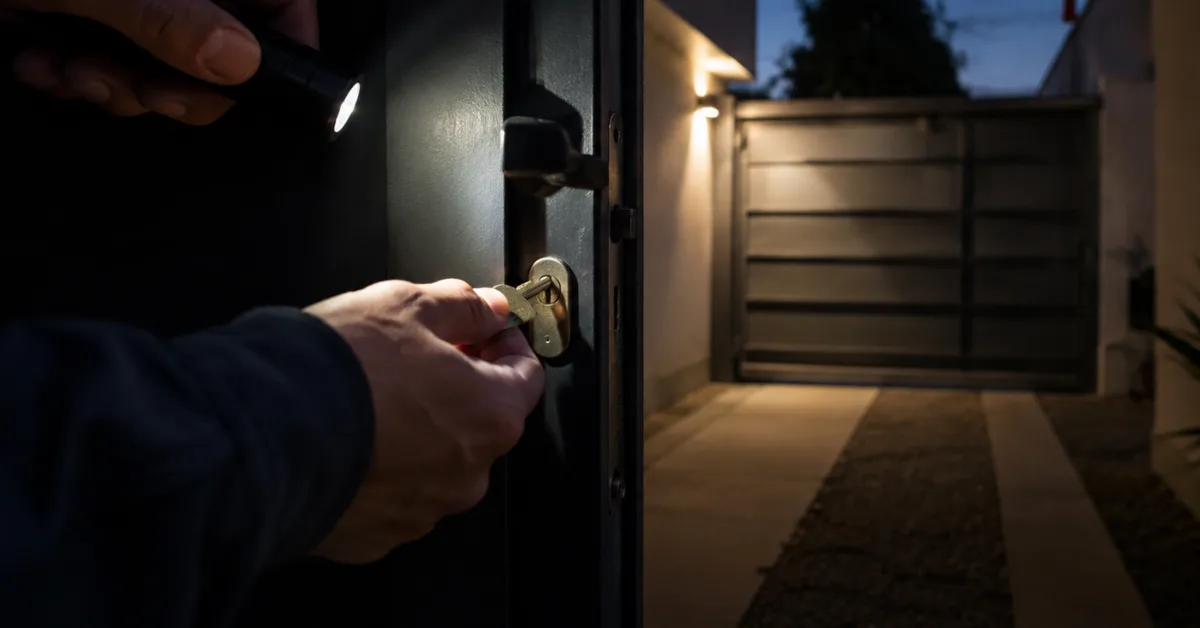
A power cut often starts with darkness, but a completely different problem can appear at the front door. Electric door releases, intercoms, keypad locks, garage doors, underground car park entrances and some smart-home locks need electricity. If the supply fails, your normal way in or out may suddenly stop working. Thinking about this in advance prevents a short power cut from becoming an unnecessary trap.
First check which access points around your home actually depend on electricity. It is not only garage doors. Entrance doors in blocks of flats, electric garden gates, barriers, sliding doors and locks operated by fingerprint, PIN code or app may also be affected. Ask one simple question: can I open this door from both inside and outside when neither mains power nor the internet is available?
A mechanical key therefore remains one of the most reliable fallbacks. If you normally use only a fob, smartphone or fingerprint, check that a traditional key exists and actually works. Keep it in a fixed, accessible place. A spare key held by someone you trust can provide another option. Do not hide keys in obvious places around the front door.
With an electric garage door, you should know how the intended emergency release works. Many drives can be disconnected from the motor so that the door can then be moved by hand. The procedure varies by model, so read the instructions beforehand and test it in good light and under safe conditions. This is especially important if the garage has no second entrance: establish whether the emergency release can also be reached from outside.
Never pull or push a jammed gate or door with force. A heavy garage door, tensioned spring or damaged drive can cause serious injury. If a door does not move normally after the correct release procedure, leave it closed and have it checked by a qualified technician.
A quick survey is worthwhile in blocks of flats too. Does the main entrance work without electricity? Is there a mechanical lock cylinder? How do you leave the underground car park? Who knows how to release the vehicle entrance manually? Clarify these questions with the property manager or owners' association before an outage. Escape and rescue routes must never be blocked or altered without authorisation.
Also think about what happens after dark. Keep a torch where you can reach it before walking to the door. A small light on your key ring can be particularly useful. Label essential mechanical keys clearly, but do not put your full address on them in case the keys are lost.
For battery-powered electronic locks, remember that mains power and battery power are not the same thing. Some systems continue operating during an outage, while others also depend on a hub, Wi-Fi or a cloud connection. Check how your own system really works and keep spare batteries if the manufacturer recommends them. Do not assume an app alone will be enough in an emergency. For more complex installations, also note where the manual and release tool are kept and, where appropriate, the phone number of the responsible building or door technician.
Finally, carry out a simple blackout access test: put the smartphone aside, do not use electric openers and try every important access point mechanically. Can every family member get out and back in? Can the vehicle be taken out of the garage? Is the emergency release easy to understand? Ten minutes of preparation can prevent you from ending up outside your own door during the next power cut.
Guides
General
13.08.2026
Locked out in a blackout? Keep doors, gates and access points working without power
Electric door releases, garage doors and smart locks can become a problem during a power cut. Check now how you can leave and re-enter your home safely without mains electricity.